On this page
Our free Christmas bingo prints as many different cards as you need, each with 24 holiday words and a free center square, plus a calling sheet for the host. Add your family or office name to the top, then print a PDF or run the calls from a phone or TV. It works for kids, grown-ups and mixed crowds of 4 to 60.
Christmas Bingo
How to play: Give each player a different card and a handful of markers (candy, buttons or a pen). The caller cuts up the calling sheet, or uses Play mode, and reads out one word at a time. Players mark that picture word if it's on their card. The center square is free.
- Santa
- Reindeer
- Snowman
- Candy Cane
- Stocking
- Mistletoe
- Wreath
- Ornament
- Gingerbread
- Sleigh
- Snowflake
- Hot Cocoa
+ 34 more in the printable.
Bingo is the game you can hand to anyone. Grandma knows how it works, the six-year-old catches on in one round, and the coworker who hates party games will still mark a square when “Fruitcake” gets called.
What’s on the printable
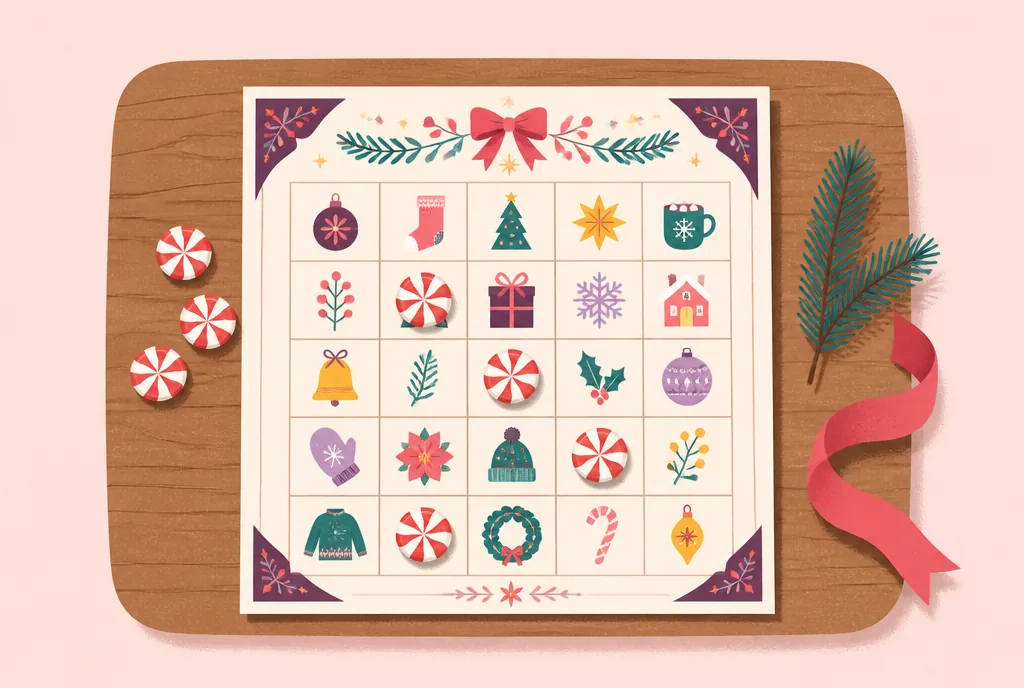
Every card is a 5×5 grid drawn from a pool of 46 Christmas words: Santa, Reindeer, Candy Cane, Mistletoe, Ugly Sweater, Nutcracker, Snow Globe, Advent Calendar and the rest. The center square is always FREE.
Each card gets its own random mix, so no two players hold the same card. The Game Maker also prints a calling sheet with every word on it. Cut that sheet into slips and pull them from a hat, or read down the list and tick them off.
- Cards: one or two per page, your choice. One per page gives bigger squares.
- Header: an optional name at the top, like “The Garcia Family” or “Third Floor Holiday Party”.
- Calling sheet: all 46 words, for the host.
- Footer: a small partygamebook.com credit. That’s it. No email sign-up, no watermark across the card.
How to play Christmas bingo
- Print one card per player and one calling sheet. Cut the calling sheet into slips if you want to draw them from a stocking.
- Hand out markers. Anything small and flat works (see the supplies box below), or let people cross squares off with a pen.
- The caller draws one word, reads it out clearly and sets the slip aside so it can be checked later.
- Players mark that word if it’s on their card. Remind everyone that the center square counts from the start.
- The first player with five marked squares in a row, across, down or corner to corner, calls out “Bingo.”
- Check their marked words against the slips you’ve called. If it checks out, they win the round. If not, keep calling.
- Clear the cards and play again. Most groups are happy with three to five rounds.
How long does a round take? With a 46-word pool and a standard five-in-a-row win, our editors’ math (a quick computer simulation of thousands of games) says a room of 10 to 20 players usually has a winner after about 14 to 17 calls. At a relaxed pace, that’s a round of roughly 3 to 5 minutes. A blackout game, where someone has to fill the whole card, takes almost the entire calling list.
- Printed cards, one per player, plus a few spares
- The calling sheet, cut into slips
- A hat, bowl or stocking for the slips
- Markers: mini marshmallows, peppermints, red and green candies, buttons, or a pen per player
- Small prizes, one per round
- Card stock or clipboards if people will play on their laps
How many cards to print
Print one card per player, then add five extras. Somebody’s cousin always shows up late, and a kid will spill cocoa on a card by round two.
If you plan to play more than one round with pens instead of markers, print a fresh card per player per round, or slide the cards into clear sheet protectors and use dry-erase markers. That second trick saves a lot of paper at a big office party.
For a crowd over 40, split into two rooms or tables with a caller at each, or run Play mode on a TV so everyone in the back can see which words have been called.
Keep the called slips in a separate pile, in order. When someone yells “Bingo” you can check their card in ten seconds instead of trying to remember whether you called “Holly” or “Wreath”.
Ways to change it up
For small groups
With four or five players, a single line can take a while to land, so try winning patterns that come up faster: any four corners, or any line of four touching the free space. Or give everyone two cards to play at once.
For big groups and office parties
Big rooms produce quick winners and occasional ties. Decide ahead of time what happens with a tie. A tiebreaker question works (“closest guess to how many cookies are on that plate”), or both winners pick from the prize table. For a longer final round, play blackout.
For kids
Pre-readers can play with a grown-up or older sibling reading the words. Hold up the slip while you call it so kids can match the letters. For little ones, play “first to three squares” so everyone has a shot at winning. Food markers are tempting with this age; buttons or paper squares are less likely to vanish before the game ends.
For a classroom party
Print one card per student plus a few extras, and give each child a small cup of paper squares or cereal pieces as markers. With 25 kids, you’ll get a winner quickly, so plan several rounds and a small prize bag. For students who are still learning to read, write each word on the board as you call it. A class party slot is usually 20 to 30 minutes, which fits four or five rounds with time to clear cards between them.
For seniors and mixed ages
Print one card per page for larger squares, call slowly and repeat each word twice. A pen is easier than tiny markers for anyone with shaky hands. If you’re running an activity for a senior living group, our printable games for seniors include more large-print options.
For grown-ups only
Turn the calls into small challenges. When “Ugly Sweater” comes up, anyone wearing one marks an extra square. When “Carolers” comes up, the caller doesn’t read the word; they hum a Christmas song and players have to name it. It slows the game down in a good way.
Different winning patterns
Once people have the hang of it, announce a new pattern each round: an X through the center, a plus sign, a full frame around the edge, or the letter T. Draw the pattern on a whiteboard or hold up a sample card so there’s no arguing later.
Prize ideas
Bingo prizes should be small and quick to hand over, since you’ll give out several. A few ideas that work for most crowds:
- A candy cane, hot cocoa packet or a small bag of cookies
- A cheap ornament, which can go straight on the tree
- Scratch-off tickets for an adult crowd
- “First pick” from the gift exchange pile, which costs nothing
- For kids, a sheet of stickers, a small toy or a pencil topper
If you have one bigger prize, save it for the blackout round at the end.
More Christmas games to pair with bingo
Bingo fills 15 to 20 minutes nicely. If you want a quiet game for people to work on while they wait for dinner, our Christmas word search prints free with an answer key:
Christmas Word Search
How to play: Print one puzzle per player or team and hand out pencils. Words hide across, down and diagonally. Circle each word you find and cross it off the list.
- REINDEER
- SNOWMAN
- MISTLETOE
- ORNAMENT
- GINGERBREAD
- STOCKING
- WREATH
- SLEIGH
- TINSEL
- HOLLY
- CAROLS
- CHIMNEY
+ 6 more in the printable.
For a full party lineup, see our Christmas party games for families or, for a grown-up crowd, Christmas party games for adults. Trivia fans can read questions straight off our Christmas trivia questions and answers, and every other holiday game we have is on the Christmas games page.
Questions hosts ask
How many Christmas bingo cards should I print?
One per player plus about five spares. If you'll play several rounds with pens, print a card per player per round or use sheet protectors and dry-erase markers.
How long does a game of Christmas bingo take?
A standard five-in-a-row round with 10 to 20 players usually ends after about 14 to 17 calls, roughly 3 to 5 minutes. Blackout rounds take most of the calling list.
Are the bingo cards all different?
Yes. Each card gets its own random mix of 24 words from a pool of 46, so no two players hold the same card.
What can I use as bingo markers?
Mini marshmallows, peppermints, buttons, paper squares or a pen. Buttons and paper work best with small kids, who tend to eat the candy.
Is this Christmas bingo good for a large group?
Yes. It works for up to about 60 players. For big rooms, use Play mode on a TV so everyone can see the called words, and decide on a tiebreaker ahead of time.
By the Party Game Book editors. Every game here is free to print for personal, classroom and non-commercial use. How we make and check our games.