56 group games for orientation leaders, teachers, outdoor educators, coaches, RAs and youth leaders. Filter by group size, age, space, time and energy, open any game for setup, rules, safety notes and debrief questions, and print the ones you need as facilitator cards.
- No ads
- No sign-up or email
- Free to print and copy for your group
Game finder
Pick what you know about your group. Every filter is optional, and the results update as you go.
No games match all of those filters. Try removing one, or widen the group size.
Icebreakers and get-to-know-you games 13 games
Low-risk openers for a room of people who don’t know each other yet. Nobody has to perform, and everyone talks to someone new within the first few minutes.
Two Truths and a Lie
Also called: Two Truths, One Lie
Each person shares three statements about themselves; the group guesses which one is made up.
How to run it
Setup
Give everyone a minute to think of two true facts and one believable lie. Paper helps people who freeze when put on the spot.
How to play
- Sit or stand in a circle, or split a big group into circles of 6 to 8.
- One person says three short statements in any order, for example: “I’ve been to Alaska. I have a twin. I can’t whistle.”
- Everyone else votes on which one is the lie, by show of hands or by holding up one, two or three fingers.
- The speaker reveals the lie and, if they like, tells the story behind one of the truths.
- Move to the next person until everyone has had a turn.
Safety
- Tell the group up front to keep facts light. This is not the place for medical, family or trauma details.
Facilitation tips
- Go first yourself. Your example sets the tone and the level of detail.
- The best lies are boring and the best truths are surprising. Say so; it makes the game better.
- With more than 10 people, use small circles so it doesn’t drag.
Debrief questions
- Which truth surprised you most?
- What did you assume about someone that turned out to be wrong?
Variations
- Theme it to your group: “two truths and a lie about my summer” or “about my job.”
- Write the three statements on a card, collect them, and read them aloud anonymously; the group guesses whose card it is.
Find Someone Who
Also called: People Bingo, Human Bingo, Signature Hunt
A mixer where people circulate with a grid of prompts and collect a different name for each square.
How to run it
You need
A printed grid per person, pens.
Setup
Make a grid of 9 to 25 squares, each with a prompt like “has lived in another state” or “can play an instrument.” Print one per person.
How to play
- Hand out grids and pens. Explain that each square needs the name of a different person.
- People walk around, ask one question at a time, and write the name of anyone who fits.
- The first person to fill a row (or the whole card, for a longer game) calls out.
- Check a few answers out loud: “Who here has lived in another state? Tell us where.”
Safety
- Avoid prompts about money, religion, health, body size or family structure. Stick to experiences and preferences.
Facilitation tips
- Write a few prompts that almost nobody fits (“has met a famous person”); they spark the best conversations.
- Add a rule that you can only ask one question per person before moving on, so people actually mix.
- For new students or staff, include prompts that point to shared logistics: “lives in the same building as you.”
Debrief questions
- Which square was hardest to fill?
- Who did you learn something unexpected about?
Variations
- For young kids, use picture prompts (“has a dog”) and let them collect a sticker instead of a name.
- For a hybrid or online group, paste the grid into chat and use breakout rooms of three.
Silent Line-Up
Also called: Birthday Line-Up
The group arranges itself in order (by birthday, height or distance traveled) without talking.
How to run it
Setup
Mark a start and end point: a wall, two chairs, a line of tape.
How to play
- Tell the group the order: birthdays from January 1 at this end to December 31 at that end.
- Once you say go, nobody may speak or write. Gestures and fingers are fine.
- When the group thinks it’s done, go down the line and have each person say their birthday out loud.
- Anyone out of place moves, and the group gets a laugh about who’s in the wrong spot.
Safety
- Avoid sorting by age, weight, or anything people may not want to reveal. Birthday month and day, shoe size and “how far you traveled today” are safe.
Facilitation tips
- Time it, then run a second sort and see whether they beat their time. Now it’s a team challenge.
- Watch who takes charge and who waits. That’s useful material for a debrief later.
Debrief questions
- How did you communicate without words?
- Who led, and how did the group decide to follow them?
Variations
- Outdoors, have them stand on a bench or a line of logs and re-sort without stepping off (adds light contact and a spotting need).
- Sort by first name A to Z: it doubles as a name game.
Common Ground
Also called: Things in Common
Small groups race to find a list of things all members have in common, beyond the obvious.
How to run it
You need
Paper, pens.
Setup
Split into groups of 3 to 5. Give each group a sheet of paper.
How to play
- Each group has five minutes to list things that are true of every person in the group.
- Rule out the obvious: “we all have shoes” and “we’re all in this room” don’t count.
- When time is up, each group reads its two most surprising items.
- Optionally, have groups name themselves after one item (“The Left-Handed Middle Children”).
Safety
- Remind people they don’t have to answer every question a group asks. “Pass” is always fine.
Facilitation tips
- Set a number to beat (for example, 10 items) so groups have a target.
- Mix groups so friends aren’t together. Counting off works.
Debrief questions
- What did you have in common that you’d never have guessed?
- How did your group decide what to ask next?
Variations
- Add a second round: one thing that is unique to each person in the group.
Four Corners
Also called: This or That, Corners
Call out a question with up to four answers; people walk to the corner that matches theirs.
How to run it
You need
Four signs (optional).
Setup
Label four corners of the room, or just point. Prepare 8 to 12 light questions with two to four choices.
How to play
- Read a question and assign each answer to a corner: “Beach, mountains, city, or stay home?”
- Everyone walks to their corner.
- Give each corner 30 seconds to talk about why they chose it.
- Ask one person per corner to share a reason, then call the next question.
Safety
- Keep choices about preferences, not identity or opinion on divisive topics, until the group knows each other well.
- If someone can’t move easily, let people point or hold up one to four fingers instead of walking.
Facilitation tips
- Start silly (“cereal before milk or milk before cereal?”) and get slightly more personal as you go.
- Use the corners to form small groups for the next activity.
Debrief questions
- Which question split the room in a way you didn’t expect?
Variations
- Two-answer version: one wall for each choice. Our would you rather questions work well here, including a kids’ list.
Step Into the Circle
Also called: Have You Ever?, Cross the Line
Everyone stands in a circle; the leader calls out an experience and anyone who has had it steps in.
How to run it
Setup
A large open circle, or two lines facing each other.
How to play
- Explain: when I read something that’s true for you, step into the circle. Look around, then step back.
- Start with easy, low-stakes prompts: “Step in if you’ve ever been on a plane.”
- After a few rounds, let group members call prompts too.
- Close with a prompt that includes nearly everyone, like “Step in if you’re glad you came.”
Safety
- Do not use “never have I ever” style prompts about risky behavior, and do not use prompts about hardship (illness, divorce, money) with a new group.
- Remind people they can stay put for any prompt, true or not, without explaining.
Facilitation tips
- Pause for a second after each step-in. The noticing (“oh, you too?”) is the point.
- With teens, collect prompts on cards first so you can screen them.
Debrief questions
- Was there a moment you felt less alone?
- What did you learn about the group as a whole?
Variations
- Seated version: raise a hand or stand up from your chair instead of stepping in.
Inside-Outside Circles
Also called: Concentric Circles, Speed Chat
Two circles face each other and talk in pairs for one minute, then the outer circle rotates.
How to run it
You need
A timer.
Setup
Count off by twos. Ones form an inner circle facing out; twos form an outer circle facing in, each opposite a partner.
How to play
- Ask a question. Partners each get 30 to 45 seconds to answer.
- Call time. The outer circle moves one person to the left.
- Ask a new question for the new pair. Repeat for five to eight rounds.
Safety
- Leave enough room between pairs that people can hear without leaning in close.
Facilitation tips
- Write the questions on a slide so you aren’t rushed.
- Use a chime, not a shout, to call time; the room gets loud.
- With an odd number, join in yourself or make one trio.
Debrief questions
- Which conversation would you like to continue later?
Variations
- Lines instead of circles: two facing lines, and one line shifts down one spot each round.
Question Ball
Also called: Toss-a-Question
A ball with questions written on it gets tossed around; whoever catches it answers the question under their thumb.
How to run it
You need
A beach ball or soft ball, marker.
Setup
Write 20 to 30 short questions on an inflatable ball with a permanent marker, spread across the surface.
How to play
- Stand in a circle. Toss the ball to someone and call their name.
- The catcher reads the question closest to their right thumb and answers it.
- They toss the ball to someone who hasn’t had it yet.
Safety
- Underhand tosses only, and call the name before you throw.
- If anyone uses a wheelchair or has limited grip, pass or roll the ball instead.
Facilitation tips
- Allow a “swap”: the catcher can answer the question under their left thumb instead.
- Keep a spare question list in your pocket if the ball gets worn.
Debrief questions
- Which answer would you like to hear more about?
Variations
- No ball? Write questions on slips in a bag, or roll a die and match the number to a list.
Take What You Need
Also called: Pick Your Number
People take as many small items as they like before they know the catch: they share one fact about themselves per item.
How to run it
You need
A roll of paper strips, buttons, or wrapped candy.
Setup
Pass around a bowl of small objects (buttons, paper clips, colored strips of paper) and say only “take as many as you think you’ll need.”
How to play
- Once everyone has some, reveal the rule: share one fact about yourself for each item you took.
- Go around the circle. Big takers will laugh; let them pick quick facts.
- Cap it at five facts per person if the group is large.
Safety
- If you use candy, check for allergies first and choose something individually wrapped, or use non-food items.
Facilitation tips
- Don’t hint at the catch, but don’t let anyone take 40. “A handful at most” keeps it reasonable.
- Colored items can have themes: red = a favorite, blue = a place, green = a goal.
Debrief questions
- What did you learn about someone that you’d ask them more about?
Variations
- Roll a die instead of taking items: share that many facts.
Partner Introductions
Also called: Interview and Introduce
Pairs interview each other for a few minutes, then each person introduces their partner to the group.
How to run it
Setup
Pair people who don’t know each other. Post three or four interview questions.
How to play
- Give pairs three minutes each to interview each other.
- Bring the group back together. Each person introduces their partner in 30 seconds.
- The person being introduced may correct or add one thing.
Safety
- Tell people before the interview that their partner will share the answers aloud, so they can choose what to say.
Facilitation tips
- Good questions: Where did you grow up? What are you hoping to get out of this? What’s something you’re good at that wouldn’t show up on a resume?
- With more than 20 people, introduce within tables or small groups, not to the whole room.
Debrief questions
- What was it like to hear someone else describe you?
Variations
- Introduce your partner in the first person, as if you were them. It’s funny and makes people listen closely.
Everyone Who
Also called: The Big Wind Blows, All My Neighbors, Move Your Seat
A musical-chairs-style game: the person in the middle names something true of themselves, and everyone it’s true for must find a new seat.
How to run it
You need
One chair per person, minus one.
Setup
Arrange chairs in a circle, one fewer than the number of players. One person starts in the middle.
How to play
- The middle person says “Everyone who…” and something true for them: “…has a younger sibling.”
- Everyone it applies to stands and moves to a different empty chair, at least two seats away.
- The middle person grabs a seat too. Whoever is left standing is the new caller.
Safety
- Set a walking-only rule and a “no sliding into chairs” rule; this is the game where people get bruised.
- Use sturdy chairs without wheels. Spot markers on the floor work for groups that can’t easily sit and stand.
Facilitation tips
- If someone gets stuck in the middle more than twice, let them pick a friend to swap with.
- Add a wild card: “Everybody move!”
Debrief questions
- What did you learn about the group that you didn’t know?
Variations
- Seated version for limited mobility: everyone it applies to raises a hand and waves to someone across the circle.
One Thing in My Bag
Also called: Pocket Show-and-Tell
Everyone picks one ordinary object they have with them and uses it to tell the group something about themselves.
How to run it
Setup
Nothing to prepare. Ask people to look in their bag, pockets or wallet.
How to play
- Give everyone 60 seconds to choose an object that says something about them.
- Go around the group. Each person holds up the object and explains it in under a minute.
- Phones count only if they show a photo, not an app.
Safety
- Some people carry very little. Offer a backup: describe an object at home you’d save in a fire.
Facilitation tips
- Model it with something mundane, like a grocery receipt, to show it doesn’t need to be meaningful to be interesting.
Debrief questions
- Whose object told you the most?
Variations
- Outdoors: everyone finds one natural object within 20 steps that describes their week.
Six-Word Introductions
Also called: Six-Word Intros
Each person introduces themselves in exactly six words, then explains them if they choose.
How to run it
You need
Index cards, pens.
Setup
Hand out index cards. Show an example of your own, like “Teacher. Runner. Burns toast every morning.”
How to play
- Give people three minutes to write six words about themselves.
- Go around and read them aloud, with no explanation the first time through.
- Then open the floor: anyone may ask about one card.
Safety
- Writing can feel like a test for some people. Say that fragments are fine and spelling doesn’t count.
Facilitation tips
- Post the cards on a wall for the rest of the event. People read them during breaks.
- It also works as a closer: “six words about today.”
Debrief questions
- Which card made you want to know more?
Variations
- Pairs write a six-word introduction for each other after a short interview.
Name games 5 games
Short, repeatable games that get names to stick. Run one in the first session and a different one in the second, and most groups know each other by the third.
Name and Motion
Also called: Name and Gesture
Each person says their name with a movement; the whole group repeats both.
How to run it
Setup
Stand in a circle where everyone can see everyone else.
How to play
- The first person says their name and makes a simple motion: a wave, a hop, a fake golf swing.
- The whole group repeats the name and the motion together.
- Go around the circle until everyone has had a turn.
- Run it once more, fast, with the group doing every name and motion in order.
Safety
- Offer seated or upper-body-only motions so nobody is excluded. Say this before the first turn, not after someone struggles.
Facilitation tips
- People who freeze can borrow a motion from the person before them.
- In the second round, point to someone at random and the group calls their name and does their move.
Debrief questions
- Whose name will you remember tomorrow, and why?
Variations
- Name and sound: replace motions with a sound effect. Good for a seated or virtual group.
Adjective Name Chain
Also called: Alliteration Names, Name Chain
Each person adds an adjective that starts with the same letter as their name, then repeats every name before theirs.
How to run it
Setup
Sit or stand in a circle.
How to play
- The first person says an adjective plus their name: “Jolly Jasmine.”
- The second says the first person’s, then their own: “Jolly Jasmine, Marvelous Mike.”
- Keep going around the circle; each person recites the whole chain before adding theirs.
- The person who started finishes by saying the entire chain.
Safety
- Teens may choose adjectives meant to embarrass someone. Set the rule: adjectives about yourself, and positive or neutral only.
Facilitation tips
- Let anyone ask the group for help. The group calling out a name together is half the fun.
- Put people who are nervous about memory near the start of the chain.
Debrief questions
- What tricks did you use to remember the chain?
Variations
- Use a food or an animal instead of an adjective: “Mango Maya.”
- For groups over 20, run chains in two circles and then swap halves.
Blanket Drop
Also called: Name Drop, Curtain Name Game
Two teams crouch on either side of a raised blanket; when it drops, the two people facing each other race to say the other’s name.
How to run it
You need
A large blanket or tarp.
Setup
Run a quick name round first. Two leaders hold a blanket up like a curtain between two teams.
How to play
- Each team quietly sends one person to crouch right behind the blanket.
- Count to three and drop the blanket.
- The first of the two to say the other person’s name correctly wins; the other joins the winner’s team.
- Play until one team is very small, or for about ten minutes.
Safety
- Hold the blanket high enough that nobody is tempted to grab it. Keep crouchers a step back from it.
Facilitation tips
- Add a twist later: two people go behind the blanket with their backs to it, and their teammates give clues until they can name the person behind them.
Debrief questions
- Whose name finally stuck, and how?
Variations
- Use a large sheet or a coat held up by two people if you don’t have a blanket.
Name Toss
Also called: Name Ball, Name Juggle
Players toss a soft ball across the circle, saying the catcher’s name before each throw.
How to run it
You need
Soft balls or rolled socks.
Setup
Stand in a circle. Start with one soft ball.
How to play
- Say the name of the person you’re throwing to, then toss underhand.
- They say “Thank you, [your name],” then call someone new and throw.
- Once everyone has caught the ball once, start adding a second and third ball.
Safety
- Soft objects only, underhand only. Make eye contact before you throw.
Facilitation tips
- If the group stalls, ask anyone whose name hasn’t been called to raise a hand.
- This leads straight into Group Juggle, the team challenge version.
Debrief questions
- What helped you remember names faster: hearing them, saying them, or both?
Variations
- For a seated group, roll a ball across a table or the floor.
Name Tag Swap
Also called: Whose Tag Is It?
Everyone gets someone else’s name tag and has to find its owner, learning one fact before handing it over.
How to run it
You need
Name tags, a marker.
Setup
Have people write their names on tags as they arrive. Collect them and shuffle.
How to play
- Hand each person a tag that isn’t theirs.
- Everyone searches for the owner of their tag, asking around.
- Before handing over the tag, learn one fact about the owner.
- Optionally, have a few people introduce the owner they found.
Safety
- Give people who don’t want to mingle a job, like collecting stray tags, so they can still take part.
Facilitation tips
- Use first names in large print. Last names slow it down.
- Ends naturally: once you have your own tag back, wear it.
Debrief questions
- How many new names do you think you learned?
Variations
- Add a photo or doodle on the tag so the hunt has a clue.
Culture, identity and background 5 games
Get-to-know-you activities for groups with different backgrounds, languages and home towns. Every one of them is opt-in: people share what they want to share, and nobody is asked to speak for a whole culture.
The Story of Your Name
Also called: Name Stories
People tell the story behind their name: who chose it, what it means, what they like to be called.
How to run it
Setup
Share your own name story first, in under a minute.
How to play
- Ask people to share anything they know about their name: its meaning, who chose it, a nickname, how to say it.
- Go around the circle, or share in groups of four or five.
- Ask each person what they prefer to be called and how to say it correctly.
Safety
- Some people don’t know their name’s story, were adopted, or have changed their name. Make it clear that “I’ll just tell you what I like to be called” is a full answer.
Facilitation tips
- This is the single best way to learn how to pronounce everyone’s name. Write down phonetic spellings if you’re the leader.
- Give each person a time limit; some name stories run long.
Debrief questions
- What did you learn about the people in this room from their names?
Variations
- Pairs share with each other first, then each introduces the other’s name.
Human Map
Also called: People Map, Where Are You From?
The floor becomes a map. People walk to the spot that matches a question, like where they were born or where they’d most like to visit.
How to run it
You need
A few objects to mark landmarks.
Setup
Mark north and a center point (your city or school). Put an object down for a few anchors, such as the coasts.
How to play
- Ask: “Stand where you grew up.” People find their spot and talk to whoever is near them.
- Ask a few people to say where they are and one thing about it.
- Run two or three more questions: where you live now, where you’d love to go, where your favorite food comes from.
Safety
- Use “where did you grow up” or “where did you live at age ten,” never “where are you really from.” Let people pick any place that matters to them.
Facilitation tips
- Outdoors, a big field works better than a classroom. Draw the map in chalk if you can.
- Groups from one town can use a local map: neighborhoods, schools, streets.
Debrief questions
- Who did you find near you that you didn’t expect?
Variations
- World version for international groups; county or campus version for local ones.
Greetings Exchange
Also called: Hello Around the Room
Group members teach each other greetings from languages they know, then mingle using them.
How to run it
Setup
Ask beforehand who would like to teach a greeting. Don’t put anyone on the spot.
How to play
- Volunteers teach a greeting (a word, a phrase, a gesture) and say where it’s used.
- Everyone mingles for three minutes, greeting as many people as they can, using a different greeting each time.
- Bring the group back and ask the teachers whether anyone pronounced theirs well.
Safety
- Only teach greetings people know from their own lives. Don’t assign someone a language based on how they look or sound.
- Handshakes, bows and fist bumps are all optional. A wave always counts.
Facilitation tips
- Have volunteers check your pronunciation before you repeat anything to the group.
- Sign language greetings are a good addition if you know them or a participant offers to teach.
Debrief questions
- What did it feel like to be greeted in a language you don’t speak?
Variations
- If nobody volunteers, teach two greetings yourself from a reliable source and say where you learned them.
A Dish From Home
Also called: Food Memories
People describe a food that reminds them of home, a holiday or a person, and the story that goes with it.
How to run it
Setup
Small groups of four to six work best.
How to play
- Ask: “Describe a dish that reminds you of home or of someone you love. Who makes it? When?”
- Each person shares for about a minute.
- Ask each group to report one dish they now want to try.
Safety
- “Home” can be complicated. Say that any food memory counts: a school lunch, a friend’s kitchen, a restaurant.
Facilitation tips
- Food stories are a gentle way into culture and family. They rarely put anyone on the spot.
Debrief questions
- What do the dishes say about where this group comes from?
Variations
- Build a group “menu” on chart paper. It makes a great wall display.
Tradition Swap
Also called: Holiday and Family Traditions
Each person writes down a tradition from their family, school, team or town; the group shares and finds patterns.
How to run it
You need
Index cards, pens.
Setup
Hand out index cards. Give one example from your own life.
How to play
- Each person writes one tradition and who takes part in it. It can be big (a holiday) or tiny (Friday pancakes).
- In groups of four, share cards and talk about why each tradition matters.
- Each group picks one thing their traditions had in common and reports it.
Safety
- Don’t ask people to explain or defend a religious or cultural practice. Questions should be “tell me more,” never “why do you…?”
Facilitation tips
- Workplace and team traditions count too, which is helpful for groups who’d rather not talk about family.
Debrief questions
- What tradition would you like this group to start?
Variations
- Closing version: the group invents one small tradition of its own for the rest of the program.
Energizers and warm-ups 10 games
Two-to-ten-minute games for the slump after lunch, the start of a long day, or a group that has been sitting too long.

Rock-Paper-Scissors Tournament
Also called: RPS Cheerleaders, Champion
Everyone plays rock-paper-scissors; losers become the winner’s loud cheering section until two giant crowds face off.
How to run it
Setup
Nothing to prepare. Works in a crowded room.
How to play
- Everyone finds a partner and plays one round of rock-paper-scissors.
- The loser becomes the winner’s biggest fan, follows them and chants their name.
- Winners find other winners and play again, fans in tow.
- Keep going until two players remain with half the room each behind them. Play the final.
Safety
- Tell people to walk, not run, between matches, especially in a packed room.
Facilitation tips
- Learn names first, so the chanting works. If not, “Go, Blue Shirt!” is fine.
- It’s the fastest energizer there is for a large crowd.
Debrief questions
- How did it feel to lose and still be part of a win?
Variations
- Best two out of three for the final, with the whole room shouting the count.
Zip Zap Zop
Also called: Zip Zap Boing
A fast passing game: players send an imaginary bolt of energy across the circle with the words zip, zap and zop, in order.
How to run it
Setup
Stand in a circle.
How to play
- The first person claps and points at someone, saying “Zip.”
- That person points at someone else and says “Zap.” The next says “Zop.” Then back to “Zip.”
- If someone says the wrong word or hesitates, the group cheers and they restart it.
- Speed up as people get the hang of it.
Safety
- Keep it no-elimination. Being “out” defeats the point of a warm-up.
Facilitation tips
- Theater groups use this to get people focused. Eye contact is the real skill.
- Add a “boing” that bounces the zip back to the sender.
Debrief questions
- What made the group faster: speed or eye contact?
Variations
- Use three words from your subject (for example, three parts of a cell) as a review game.
Pass the Pulse
Also called: Hand Squeeze, Electric Current
Players hold hands in a line or circle and pass a hand squeeze as fast as they can, eyes closed.
How to run it
You need
A small object to grab (optional).
Setup
Everyone holds hands in a circle, or sits in a line with hands linked.
How to play
- The leader starts the pulse by squeezing the hand of the person to their right.
- Each person passes the squeeze as soon as they feel it.
- Time how long it takes to go around. Try to beat the time.
- Then try with eyes closed, or send it both ways at once.
Safety
- Some people don’t want to hold hands. Offer a light shoulder tap or a touch of elbows as an equal option, or skip to a no-contact energizer.
Facilitation tips
- Two-team version: two lines race to grab an object at the end of the line once the pulse arrives.
Debrief questions
- What happened to the time when you closed your eyes?
Variations
- Contact-free version: pass a clap or a word around the circle instead.
Giants, Wizards and Elves
Also called: Team Rock-Paper-Scissors
A team version of rock-paper-scissors with poses and a chase: the losing team runs for its safe zone.
How to run it
You need
Markers for two safe zones.
Setup
Mark a center line and a safe zone behind each team. Teach the three poses: giants stand tall and roar, wizards cast a spell, elves crouch with pointy ears.
How to play
- Giants beat wizards, wizards beat elves, elves beat giants (they run between the giants’ legs).
- Each team huddles and picks a character, plus a backup.
- Teams line up at the center line. Count to three and everyone makes their team’s pose.
- The winning team chases; anyone tagged before reaching their safe zone joins the other team. A tie means both teams freeze.
Safety
- Tag with a light touch on the shoulder or back, never a push.
- Make the safe zones far from walls and fences, with a long run-out area.
Facilitation tips
- Practice the three poses together a couple of times before the first round.
- This is a kids’ favorite. Teens like it more than they admit.
Debrief questions
- How did your team decide? Did one person always choose?
Variations
- Indoor version: no chasing; losers just sit down, and the team with players left after five rounds wins.
Wink Detective
Also called: Winker
One secret winker sends players out of the game with a wink; a detective tries to spot them.
How to run it
You need
Slips of paper.
Setup
Prepare slips: one says Winker, one says Detective, the rest are blank. Seat everyone in a circle.
How to play
- Everyone draws a slip in secret. The detective reveals themselves and stands in the middle.
- The winker winks at players one at a time. A player who is winked at waits a few seconds, then says “I’m out” and leans back.
- The detective gets three guesses to name the winker.
- Shuffle the slips and play again.
Safety
- Some people can’t wink or can’t see small facial movements. Offer a different signal: a tongue out, or a slow blink.
Facilitation tips
- Players who are out make great hecklers. Let them keep watching.
- With older kids and adults you can play the traditional version with a dramatic “fall.” For younger groups, keep it to “leaning back.”
Debrief questions
- What gave the winker away?
Variations
- Two winkers who don’t know each other, and the detective must find both.
Animal Families
Also called: Animal Sounds
Everyone gets an animal on a slip and, without words, finds the rest of their animal family by sound alone.
How to run it
You need
Slips of paper with animal names.
Setup
Write one animal per slip, three to six slips per animal. The number of animals sets the size of the groups you’ll get.
How to play
- Hand out slips face down. Everyone reads their own and hides it.
- On go, people make their animal’s sound and move around the room to find their family.
- When a family is complete, they sit or crouch together.
- Use the families as groups for the next activity.
Safety
- The eyes-closed version needs a clear, open floor and spotters along the edges. Keep eyes open in a crowded room.
Facilitation tips
- Choose animals with clear sounds: cow, duck, dog, cat, owl, rooster.
- Sneak in one or two silent animals (giraffe, fish) for laughs, and let those players use gestures.
Debrief questions
- How did you find your group when nobody could use words?
Variations
- Older groups: use song titles to hum instead of animals.
Count to Twenty
Also called: Group Count, Random Count
The group counts to twenty one number at a time, in no set order. If two people speak at once, start over.
How to run it
Setup
Sit or stand in a circle. Eyes closed makes it harder; eyes on the floor works too.
How to play
- Anyone may say “one.” Then anyone else says “two,” and so on.
- Nobody may say two numbers in a row, and nobody may signal who goes next.
- If two people speak at once, the group goes back to one.
- Stop when you reach the target. Twenty is hard; ten is fine for a first try.
Safety
- None beyond normal room safety. A calm game that suits any group.
Facilitation tips
- It looks impossible and then the group suddenly gets it. Let it fail a few times before you give hints.
- The trick is listening and patience, which is a nice debrief topic.
Debrief questions
- What changed when you finally succeeded?
- Who held back? Who jumped in?
Variations
- Count to the number of people in the group, so everyone must say exactly one number.
Mirror Partners
Also called: Mirror Game
Partners face each other; one moves slowly and the other mirrors every movement at the same time.
How to run it
Setup
Pairs stand or sit facing each other about an arm’s length apart.
How to play
- Partner A leads with slow movements; Partner B mirrors them like a reflection.
- After a minute, switch leaders.
- Then try with no leader at all: both follow each other.
Safety
- Slow is the rule. Fast moves make it a contest and someone gets a hand in the face.
Facilitation tips
- Ask for movements smooth enough that someone watching couldn’t tell who’s leading.
- Quiet background music helps.
Debrief questions
- What was harder: leading or following?
- What happened when nobody was leading?
Variations
- Seated version uses hands and face only, which suits older adults or a crowded room.
Shake Down
Also called: 5-4-3-2-1 Shake
Everyone shakes each limb in a loud countdown from eight to one. Takes two minutes and wakes up any room.
How to run it
Setup
Everyone stands with a little space around them. Seated works too.
How to play
- Shake your right hand eight times while the group counts out loud, then left hand, then right foot, then left foot.
- Repeat with seven shakes each, then six, and so on down to one.
- Finish with a big shout or a jump.
Safety
- Offer a seated version: hands and feet from a chair.
Facilitation tips
- Speed up as the numbers get smaller. The faster finish makes people laugh.
- Good right before a talk or a test.
Variations
- Quiet version: whisper the count. Use it in a library or a room next to a meeting.
Balloon Keep-Up
Also called: Keep It Up, Balloon Volley
Teams keep balloons in the air as long as they can, with rules that change each round.
How to run it
You need
Balloons.
Setup
Groups of five to eight. One balloon per group to start.
How to play
- Round 1: keep the balloon in the air. Count each touch out loud. Nobody may touch it twice in a row.
- Round 2: add a second balloon.
- Round 3: hands are not allowed; only elbows, heads and knees.
- Groups report their best count.
Safety
- Check for latex allergies first and use latex-free balloons if anyone is unsure.
- Clear chairs and tables from the play area.
Facilitation tips
- Hold groups in a loose circle to cut down on collisions.
- Add a rule that everyone must touch the balloon before anyone touches it again.
Debrief questions
- What did your group do differently when you added the second balloon?
Variations
- Seated version: everyone stays in their chair, and the balloon must stay above head height.
Team challenges and problem-solving 12 games
Cooperative tasks with a clear goal and no single right way to reach it. The task is the excuse; the conversation afterward is where the learning happens.
Human Knot
Also called: Tangle
Players grab random hands across a circle, then try to untangle into a single ring without letting go.
How to run it
Setup
Groups of 6 to 10 stand shoulder to shoulder in a tight circle.
How to play
- Everyone reaches into the middle with their right hand and takes a hand of someone not next to them.
- Then left hands: take a different person’s hand, again not someone next to you.
- Without letting go, the group untangles by stepping over, ducking under and turning.
- The goal is one circle (sometimes two linked ones, which counts).
Safety
- Close contact game. Use it only with groups who already know each other, and offer a role as “untangle coach” to anyone who’d rather watch.
- Allow a quick grip change if a wrist gets twisted; joints first, puzzle second.
- No stepping over arms above waist height.
Facilitation tips
- Give the group a single “re-grip” it can use without starting over. It cuts frustration.
- Some knots can’t be solved. If the group is stuck after 10 minutes, allow one pair to let go and re-join.
Debrief questions
- Who saw the solution first? How did the group hear them?
- What did you do when you got stuck?
Variations
- Contact-free version: use short ropes or bandanas between people instead of hands.
Helium Stick
Also called: Magic Stick
The group tries to lower a light pole to the ground while every person keeps a finger touching it. It keeps rising.
How to run it
You need
A long light pole (tent pole, dowel or hula hoop).
Setup
Two lines face each other. Everyone holds out their index fingers at chest height. Lay the pole across all the fingers.
How to play
- The rule: everyone’s index fingers must stay in contact with the underside of the stick. No grabbing or hooking.
- The goal: lower the stick to the ground together.
- If anyone loses contact, start again from the top.
- The stick tends to float up because everyone pushes up to stay in contact. Let the group work that out.
Safety
- Use a light pole with no sharp ends. Keep faces clear of the pole when it rises.
Facilitation tips
- Don’t explain the “helium” effect. The confusion is the point.
- Groups usually succeed once one person calls a slow count. Note who stepped in.
Debrief questions
- Why did the stick rise when everyone was trying to lower it?
- What would that look like at work or school?
Variations
- Use a hula hoop: groups of eight hold it on their index fingers and lower it the same way.
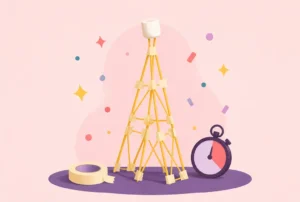
Spaghetti Tower
Also called: Tower Challenge
Small teams build the tallest freestanding tower they can from spaghetti, tape and string, with a marshmallow on top.
How to run it
You need
Dry spaghetti, masking tape, string, a marshmallow or small ball per team, a timer.
Setup
Teams of three or four. Each gets 20 sticks of dry spaghetti, a yard of tape, a yard of string and one marshmallow.
How to play
- Explain: tallest freestanding tower wins, measured from the table to the top of the marshmallow.
- The marshmallow must be on top. The tower can’t be taped to the ceiling or held.
- Give teams 18 minutes. Announce time at 10, 5 and 1 minute left.
- Measure the towers that are still standing. Then debrief before anyone cleans up.
Safety
- Use a soft ball instead of a marshmallow if any participant has food allergies or dietary restrictions, or if you’re in a room where food isn’t allowed.
Facilitation tips
- Many teams plan for 15 minutes and put the marshmallow on at the end, and the tower collapses. Teams that test early usually do better. Let them find that out.
- Take photos of the towers before measuring.
Debrief questions
- When did you first put the weight on top?
- If you had 18 more minutes, what would you do differently?
Variations
- Run it twice. The improvement between rounds is the lesson.
- Give one team member a “budget” and make the others buy materials from them.
Egg Drop
Also called: Egg Protector
Teams design a package from simple supplies that keeps a raw egg from breaking when it’s dropped.
How to run it
You need
Raw eggs, straws, tape, paper, string, a safe drop spot.
Setup
Teams of three to five. Each gets an egg and an identical kit of supplies. Choose a drop height: a ladder, a balcony or a stairwell.
How to play
- Give teams 20 to 30 minutes to design and build their package.
- Each team presents its design in 30 seconds, with a name.
- Drop the packages one at a time and check the eggs together.
- Raise the height for the survivors if you want a tiebreaker.
Safety
- An adult does all drops from height; nobody leans over railings.
- Lay a tarp at the drop zone and wash hands after handling raw eggs.
Facilitation tips
- Add a 30-second sales pitch for each package. It makes quiet team members talk.
- Hard-boiled eggs are a fallback if raw eggs aren’t allowed, but the stakes drop with them.
Debrief questions
- How did your team decide on a design?
- Did anyone have an idea that didn’t get used?
Variations
- Budget version: each material has a price, and teams must stay under a set budget.
Group Juggle
Also called: Pattern Ball
The group sets a throwing pattern, then keeps several balls moving through it at once without dropping any.
How to run it
You need
Several soft balls or stuffed toys.
Setup
Stand in a circle. Have several soft objects ready but out of sight.
How to play
- Toss one ball across the circle, saying the catcher’s name. Each person receives once and throws once, until it’s back to the leader.
- Run the same pattern again so everyone remembers who they throw to.
- Add a second ball, then a third, then more. Keep the same pattern.
- Count drops, or time how long the group keeps everything moving.
Safety
- Underhand tosses and soft objects only. Say the name first, then throw.
Facilitation tips
- Add a rubber chicken or a toy late in the game. Laughter resets frustrated groups.
- Ask the group to set its own goal (number of objects) before each round.
Debrief questions
- What made the pattern work when more balls were added?
- How did the group handle drops?
Variations
- Reverse the pattern with one ball while others go forward.
Toxic Waste
Also called: Bucket Lift
Using only ropes tied to a bungee cord, the group moves a “toxic” bucket from one container to another without touching it or crossing the boundary.
How to run it
You need
A bucket, a ball or water to fill it, a bungee cord or rubber ring, 8 to 10 ropes, a smaller container, a rope for the boundary circle.
Setup
Lay a rope circle about 8 feet across. Put the bucket in the middle and a second container outside the circle. Tie 8 to 10 ropes to the bungee ring.
How to play
- Nobody may cross into the circle or touch the bucket with their body.
- Holding only the ropes, the group stretches the ring, lowers it around the bucket and lifts.
- They carry the bucket out of the circle and pour its contents into the second container.
- If anything spills or someone crosses the line, the facilitator decides on a fair penalty, like a teammate losing their voice.
Safety
- Use water, beans or balls in the bucket. Nothing heavy, nothing that can break.
- Keep people from stepping backward onto each other’s ropes.
Facilitation tips
- Let the group plan for five minutes before touching any equipment.
- Make one person the “safety officer” whose only job is to watch the boundary.
Debrief questions
- How did the group plan? Did the plan survive the first try?
- Who did you trust to hold the rope steady?
Variations
- Blindfold half the group and give instructions only through the sighted half.
Tarp Flip
Also called: Magic Carpet
The whole group stands on a tarp and must flip it over without anyone stepping off.
How to run it
You need
A tarp or blanket.
Setup
Choose a tarp just big enough for the group to stand on with a little room to spare.
How to play
- Everyone steps onto the tarp.
- The goal: turn the tarp completely over so everyone ends up standing on the other side.
- Nobody may step off. If anyone touches the floor, start again (or add a penalty, like one person losing their voice).
Safety
- Close-contact game. Play on grass or a carpeted floor, never a slippery one. No lifting or carrying people.
- Tell people they can step off and coach from outside at any time.
Facilitation tips
- A smaller tarp makes it much harder. Fold it in half for a second round.
- Groups usually start at one corner and fold. Let them find that themselves.
Debrief questions
- How did you agree on a plan when everyone was standing so close?
- What did you do when the plan stopped working?
Variations
- No-contact version: in pairs, flip a placemat without stepping off a small square.
Survival Ranking
Also called: Stranded, Survival Scenario
Individuals, then teams, rank a list of items by usefulness in an imaginary survival situation; teams usually beat individuals.
How to run it
You need
A printed scenario and item list.
Setup
Write a scenario (stranded in a snowy forest, adrift in a lifeboat) and a list of 10 to 15 items. Hand it out.
How to play
- Each person ranks the items alone, in five minutes, without talking.
- Groups of four or five agree on a group ranking in 15 to 20 minutes. No voting or averaging: they must talk it through.
- Share an expert ranking and reasons, or have the groups argue for their top three.
- Compare individual and group scores.
Safety
- Choose scenarios that don’t echo recent local disasters or anyone’s known experience.
Facilitation tips
- Write your own scenario and item list, and get a real expert ranking from a search-and-rescue or outdoor-education source you trust before you use it.
- Watch how decisions happen: who persuades, who goes quiet, who compromises.
Debrief questions
- Did your group’s ranking beat your own?
- How did your group handle disagreement?
Variations
- Local version: “the power is out for three days” works for family or community groups.
Blind Shapes
Also called: Rope Square, Blind Polygon
With eyes closed, the group holds a loop of rope and forms the shape the leader calls: a square, a triangle, a star.
How to run it
You need
A long rope tied in a loop, blindfolds (optional).
Setup
Tie a long rope into a loop. Everyone holds it with both hands.
How to play
- Everyone closes their eyes (or wears a blindfold) and holds the rope.
- Call a shape: a perfect square.
- When the group thinks it’s done, everyone lays the rope down and opens their eyes.
- Call harder shapes: a triangle, a letter, a star.
Safety
- Clear the floor of chairs, bags and edges. Spot the group from the outside and say “bumpers up” (hands in front) if they begin to move.
- Eyes closed is always optional. Someone keeping their eyes open can be the group’s silent observer instead.
Facilitation tips
- Let the group talk on the first try. On the second, nobody may speak except one chosen leader.
Debrief questions
- How did you communicate when nobody could see?
- Who emerged as the leader, and how?
Variations
- Ask for the shape with no talking at all; tugs on the rope only.
Silent Puzzle
Also called: Broken Squares, Shared Puzzle
Each team member gets some puzzle pieces; the team must complete a set of shapes without talking or taking pieces from anyone.
How to run it
You need
Cut-up paper squares or simple puzzles, one set per team.
Setup
Cut five paper squares of the same size into a few pieces each. Mix the pieces and divide them into five envelopes. Teams of five.
How to play
- The goal: each person ends with a complete square in front of them.
- No talking, pointing or signaling. You may give a piece to someone; you may not take or ask for one.
- The team is done when all five squares are complete.
Safety
- None beyond normal classroom safety. A quiet, desk-friendly challenge.
Facilitation tips
- Test your cut squares before the session. Make sure every square needs pieces from at least two envelopes.
- Watch for the person who finishes a square quickly and then stops looking at the group. That’s the debrief.
Debrief questions
- How did it feel to give away a piece that looked useful to you?
- What did you notice about others’ squares while you worked on yours?
Variations
- Use a children’s jigsaw puzzle split among envelopes, for younger groups.
Stepping Stones
Also called: River Crossing, Lava River
The group crosses a “river” using a limited set of stepping stones that disappear if nobody is touching them.
How to run it
You need
Paper plates or carpet squares, two ropes for the riverbanks.
Setup
Lay two ropes 20 to 30 feet apart as riverbanks. Give the group fewer stones than people.
How to play
- Everyone must get from one bank to the other, touching only the stones.
- A stone must always be touched by someone; an untouched stone is taken away by the facilitator.
- If anyone touches the river, the whole group starts again (or that person goes back).
Safety
- Use non-slip stones, like carpet squares face down. No jumping between stones.
- Light contact (a hand on a shoulder for balance) is fine; no carrying anyone.
Facilitation tips
- Be strict about taking untouched stones away. It’s the rule that makes them plan.
Debrief questions
- What happened when the group lost a stone?
- Who made sure no one was left behind?
Variations
- Give a few people “injuries” (one foot only, no talking) so the group has to plan around them.
Speed Pass
Also called: Ball Relay, Group Speed Challenge
Everyone must touch the ball once, in the same order, as fast as possible. The group keeps redesigning the method to cut the time.
How to run it
You need
A soft ball, a timer.
Setup
Run a Group Juggle pattern with one ball first, so everyone knows their order.
How to play
- Time the group passing the ball through the pattern once.
- Announce the time and ask: can you do it faster? The only rules are the order and that everyone must touch the ball.
- Let the group change how they stand, how they pass, anything.
- Time each attempt. Most groups go from 30 seconds to under 3.
Safety
- Fast passing in a crowd causes collisions. Tell people to stay planted when it’s not their turn.
Facilitation tips
- Keep repeating the rules exactly: order, and everyone touches. Groups often break assumptions they made up, not rules you gave.
- Write each time on a board so they can see the improvement.
Debrief questions
- What rule did you assume that wasn’t actually a rule?
- Who had the breakthrough idea, and how did it get heard?
Variations
- Set a target (under 2 seconds) and give the group three tries.
Trust-building activities 5 games
Activities where people rely on each other, physically or emotionally. Run these after a group has played together for a while, never as a first activity, and read the safety notes first.
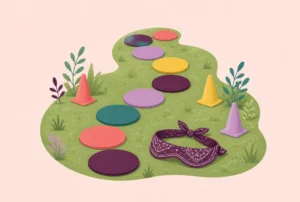
Minefield
Also called: Obstacle Walk
One partner, eyes closed, crosses a field of scattered soft objects guided only by the other partner’s voice.
How to run it
You need
Soft objects to scatter, blindfolds (optional), rope for boundaries.
Setup
Mark a rectangle with rope. Scatter soft objects (balls, cones, crumpled paper) inside. Pairs line up at one end.
How to play
- One partner closes their eyes or wears a blindfold. The other stays outside the area and guides by voice only.
- The walker crosses slowly. Touching an object means returning to the start (or just counts as a hit).
- Switch roles.
- Later rounds: all pairs go at once, so the walkers must pick out their partner’s voice.
Safety
- Soft objects only. Nothing that can roll underfoot, like marbles, or be tripped over, like chairs.
- Walkers keep “bumpers up”: hands at chest height, palms out.
- The facilitator or a spotter watches the edges and calls “freeze” if anyone heads toward a wall.
Facilitation tips
- Let pairs agree on code words before they start. They’ll invent left and right, steps and stop.
- Keep the eyes-closed walk optional. Walkers can look down at their feet only, which is still hard.
Debrief questions
- What did your guide do that helped most?
- What made it hard to hear your partner when everyone was talking?
Variations
- Team version: the whole group guides one walker, and only one person may speak at a time.
Trust Walk
Also called: Guided Walk, Blind Walk
One partner, eyes closed, is led on a walk by the other, who keeps them safe and describes what they pass.
How to run it
You need
Blindfolds (optional).
Setup
Choose a route with even ground and no stairs. Walk it yourself first.
How to play
- The guide holds the walker’s elbow or lets them rest a hand on the guide’s shoulder.
- The guide leads slowly and narrates: “Small step down. Tree on your left.”
- Halfway, the guide places the walker’s hand on an object (bark, a leaf, a railing) to identify by touch.
- Switch roles for the walk back.
Safety
- Even ground only, at walking pace. No stairs, slopes or traffic.
- Walkers may open their eyes at any time. Say this before the start, and mean it.
Facilitation tips
- Ask guides to describe things the walker can’t see: the light, the sounds, where the path turns.
- Pair people who have already worked together; trust walks with strangers can feel invasive.
Debrief questions
- What did your guide do that made you feel safe?
- What did you notice with your eyes closed that you’d normally miss?
Variations
- Silent version: guides may not speak, only touch the elbow to signal.
Back-to-Back Stand-Up
Also called: Partner Stand, Stand Up
Partners sit on the floor back to back, link arms, and stand up together by pushing against each other.
How to run it
Setup
Pairs of similar height, on a clean floor or grass.
How to play
- Partners sit back to back with knees bent and feet flat.
- Link elbows. Push back against each other and stand up together.
- Try again with three people, then four. Each extra person makes it harder.
Safety
- Not for anyone with back, knee or hip injuries, or who is pregnant. Give a no-questions-asked option to coach or time instead.
- Pair by similar height and size; never force a pairing.
Facilitation tips
- The trick is pushing back, not up. Let them discover it.
Debrief questions
- What did it take to stand up together when you couldn’t see each other?
Variations
- Hands-only version: partners face each other, hold hands and both lean back to sit and stand.
Yurt Circle
Also called: Lean In, Lean Out
The group holds hands in a circle, and alternating people lean in and out at the same time so the circle balances itself.
How to run it
Setup
Stand in a circle holding hands, feet shoulder-width apart. Count off: ins and outs.
How to play
- On a count, the “ins” lean slightly toward the center and the “outs” lean back.
- Hold the balance for a few seconds, then return to standing.
- Swap: ins become outs. Try going deeper each time.
Safety
- Keep the lean shallow on the first tries, and stop if the circle wobbles.
- Avoid if anyone has wrist or shoulder injuries. They can call the count instead.
Facilitation tips
- Groups often cheer when the circle holds. Let it run a few rounds and then debrief.
Debrief questions
- What did it take for the whole circle to hold?
- What happens to the circle if one person doesn’t trust the others?
Variations
- With a long rope loop instead of hands: everyone leans back on the rope together.
Fear in a Hat
Also called: Worries in a Hat
People anonymously write a worry about the program ahead; the group reads them aloud and responds with respect.
How to run it
You need
A hat or bowl, identical slips of paper, pens.
Setup
Use identical paper and pens so slips can’t be traced. Best on the first or second day of a program, trip or team.
How to play
- Everyone writes one sentence: “In this program, I’m worried that…” No names.
- Fold the slips and put them in a hat. Mix them.
- Each person draws a slip and reads it aloud as if it were their own, then says what they think the writer might feel.
- Nobody comments or guesses who wrote it. After all are read, ask what the group noticed.
Safety
- Set ground rules before writing: no guessing who wrote what, no jokes about any slip.
- If a slip reveals a safety or wellbeing concern, follow up privately and with your organization’s procedures. Say that this might happen before the game starts.
Facilitation tips
- Read one slip yourself first, to show the tone.
- Most groups discover that many worries are shared. Point that out.
Debrief questions
- What worries came up more than once?
- What can the group do about them?
Variations
- Hopes in a Hat: same process for what people hope to get out of the program. Good to pair with the worries round.
Debriefs, check-ins and closers 6 games
Ways to open a session, check the temperature mid-way, and close with something people will remember. Pair any team challenge with one of these.
Rose, Bud, Thorn
Also called: High, Low, Hope
Each person names a rose (a highlight), a bud (something they’re looking forward to) and a thorn (a challenge).
How to run it
Setup
Circle up or use small groups for large numbers.
How to play
- Explain the three parts with a quick example of your own.
- Go around the circle. Each person shares all three, briefly.
- Anyone can say pass on any part.
Safety
- “Thorns” can bring up something serious. Have a plan to follow up privately if they do.
Facilitation tips
- Great end-of-day ritual on trips and camps. Repeat it every evening.
- Write the buds on a board. They make a good planning list.
Debrief questions
- What did you notice about the group’s roses today?
Variations
- Kids’ version: sunny, cloudy and rainbow parts of the day.
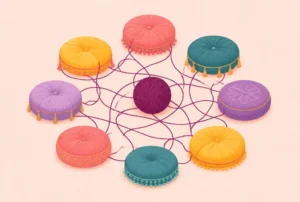
Appreciation Web
Also called: Yarn Web, Web of Thanks
The group passes a ball of yarn across the circle; each person thanks someone and holds the strand, building a web.
How to run it
You need
A ball of yarn.
Setup
Stand or sit in a circle. The leader holds a ball of yarn.
How to play
- Hold the end of the yarn and toss the ball to someone, naming one thing you appreciate about them.
- They hold the strand and toss the ball to someone else with an appreciation.
- Continue until everyone is holding the web at least once.
- Look at the web together before winding it back up.
Safety
- Make sure nobody is left out. As leader, watch who hasn’t received the yarn and nudge the throwers.
Facilitation tips
- Ask for specific appreciations: something someone did, not a general compliment.
- Cut the web at the end so everyone keeps a piece of yarn as a reminder.
Debrief questions
- What does the web show about this group?
Variations
- Toss to someone who helped you learn something, instead of an appreciation.
One-Word Whip
Also called: Word Whip
Go quickly around the group: everyone says one word that sums up how they feel right now.
How to run it
Setup
Nothing to prepare.
How to play
- Ask a question that can be answered in one word: “How do you feel about today?”
- Go around fast. No explanations.
- Repeat any words you heard more than once to the group.
Safety
- “Pass” is a valid word.
Facilitation tips
- Use it to open a meeting and again to close it. The change in words is the debrief.
- Great when you only have two minutes left.
Variations
- One gesture instead of one word, for a quiet or multilingual group.
Weather Report
Also called: Personal Forecast
People describe their mood as a weather forecast: “Mostly sunny, with a chance of thunderstorms this afternoon.”
How to run it
Setup
Nothing to prepare. Works on video calls.
How to play
- Ask everyone to give their personal weather forecast for today.
- Go around the circle. Let people elaborate if they want.
- As leader, notice who’s “stormy” and check in later.
Safety
- This is a check-in, not therapy. Keep it light, and follow up privately if someone signals trouble.
Facilitation tips
- Kids love it, and it gives them words for feelings.
Debrief questions
- What’s the forecast for the group as a whole?
Variations
- Use a scale of 1 to 5 with fingers for a quick read of a large room.
Fist to Five
Also called: Fist of Five
Everyone holds up zero to five fingers at the same time to show agreement, confidence or understanding.
How to run it
Setup
Explain the scale: a fist means “I can’t support this” and five fingers means “I’m all in.”
How to play
- Ask the question: “How ready do you feel for tomorrow?”
- On the count of three, everyone shows a hand at once.
- Ask a fist or one-finger person, if they’re willing, what would move them up a finger.
Safety
- Never make someone defend a low number in front of the group. Ask privately if needed.
Facilitation tips
- Ideal for groups making decisions: anything below three gets discussed before moving on.
Variations
- Online: type 0 to 5 in chat at the same moment.
Letter to Your Future Self
Also called: Postcard to Myself
At the end of a program, each person writes a short letter to themselves; the leader mails it back weeks later.
How to run it
You need
Paper or postcards, envelopes, pens.
Setup
Envelopes for each person to address to themselves.
How to play
- Give prompts: what you learned, what you’ll try, what you want to remember about this group.
- Give ten quiet minutes to write.
- Seal and collect the letters. Promise a mailing date and keep it.
Safety
- Promise privacy and keep it. Letters are never read by staff.
Facilitation tips
- Six weeks to three months later is about right. Long enough to be a surprise, soon enough to matter.
- Email-to-self services work for digital groups, but paper lands harder.
Variations
- Postcards that peers write to each other, mailed later.
Ready-made session plans
Four running orders we’d use ourselves. Each one starts with the lowest-risk activity and builds from there. Add a plan to your print list and you’ll get a one-page run sheet in front of the cards.
First meeting, 25 strangers, 60 minutes
Orientation groups, new classes, a new committee · 60 minutes
- Name and Motion10 min
- Inside-Outside Circles15 min
- Silent Line-Up10 min
- Common Ground20 min
- One-Word Whip5 min
Names first, then pairs, then the whole group moving together, then small teams. Each step asks a little more of people.
Team day, 12 people, 90 minutes
A staff team, a club, a student leadership group · 90 minutes
- Shake Down5 min
- Group Juggle15 min
- Speed Pass20 min
- Helium Stick15 min
- Minefield25 min
- Appreciation Web10 min
Two quick warm-ups, two problem-solving challenges that build on each other, one trust activity, and a closer.
Classroom, first day, 30 minutes
Grades 3 to 12, desks in rows · 30 minutes
- The Story of Your Name10 min
- Four Corners15 min
- Fist to Five5 min
Learn names and how to say them, get the room moving, and end with a quick check on how students feel.
Rainy-day indoor energizer, 20 minutes
Camps, youth groups, recess with 30 kids · 20 minutes
- Rock-Paper-Scissors Tournament5 min
- Animal Families5 min
- Balloon Keep-Up10 min
Loud, fast and no setup beyond balloons. Ends with kids in small groups, ready for the next activity.
How to choose and run a group game
Most games fail for the same few reasons: the wrong game for the stage the group is at, unclear instructions, or no time left to talk afterward. The notes below fix all three.
Sequence from low risk to higher risk
Start with games where nobody can get it wrong and nobody is the center of attention, then build. A group that has laughed together will try harder things. A group asked to be vulnerable in minute five will shut down.
Let people choose their level
Say at the start, and mean it: anyone may sit out any activity, no reason needed. Give people who step back a real job (timekeeper, observer, safety spotter) so stepping back doesn’t mean being left out. Outdoor and adventure educators have used this opt-out principle for decades, and in our experience people take part more, not less, when they know they can stop.
Physical and emotional safety
- Walk the space first. Remove anything people could trip on and keep games away from walls, stairs and traffic.
- Check for allergies before using food, balloons (latex) or outdoor sites with stinging insects or plants.
- Ask about injuries privately before any game with lifting, leaning or close contact, and offer a contact-free version.
- Never pressure anyone to share personal stories. “Pass” is always a full answer.
- Know your organization’s procedures if a game brings up something serious, and say before you start that you’ll follow up privately if needed.
Include everyone
- Mobility: most games here list a seated version. Plan it in from the start instead of improvising in front of the group.
- Hearing and vision: post instructions on a slide or card, face the group when you talk, and swap eyes-closed rules for “look only at the floor.”
- Language: demonstrate before you explain. Games that rely on wordplay are hard in a second language; movement and drawing games are not.
- Quieter people: pairs and small groups before whole-group sharing, and time to think or write before anyone speaks.
- Older adults: slower pace, seated options, larger print. Our printable games for seniors have large-print sheets.
Running games online
Many of the talking games work on video: Two Truths and a Lie, Weather Report, Six-Word Introductions, Fist to Five, Rose, Bud, Thorn and Tradition Swap all transfer with little change. Use breakout rooms of three or four, put the instructions in the chat, and keep each round shorter than you would in a room.
Debrief: what happened, so what, now what
A three-question pattern works for almost any activity: What? (what happened), So what? (why it matters), Now what? (what we’ll do with it). It comes from the educator Terry Borton’s 1970 book Reach, Touch, and Teach and is widely used in experiential education, alongside the 4-H “do, reflect, apply” model. Give it at least as long as you gave the game’s instructions. Some debrief questions that work across activities:
- What happened? Walk me through it from the start.
- What was the hardest moment for the group?
- When did things start to work? What changed?
- Who had an idea that didn’t get heard? What would have helped?
- What did you notice about how decisions got made?
- What did you do that helped the group? What got in the way?
- How did it feel to lead? To follow?
- Where else have you seen this happen: in class, at work, on a team?
- What would you do differently if we ran it again?
- What’s one thing you’ll try in the next week because of this?
- If this activity had a headline, what would it be?
- What do you want to thank someone in the group for?
What we left out on purpose
- Trust falls and dives. They need trained spotters and still cause injuries; they don’t belong in a quick session run from a web page.
- High ropes and climbing. These need certified staff and equipment.
- Elimination games that leave people sitting out for long stretches, and games that rank or single out individuals.
- Blindfolded running or tag. Every eyes-closed activity here is at walking pace with spotters.
Printable facilitator cards
Every game prints as a half-page card: setup, numbered steps, safety notes, tips and debrief questions, two cards to a sheet. Print the games on your list, the games your filters show, or the whole library. Cards are built in your browser and nothing is uploaded.
Ready-made PDFs of all 56 cards: US Letter · A4. For best results, print at 100% (“Actual size”). More printing help: printing tips.
For educators and librarians
No ads, no sign-up, no email wall. Free to print and copy for your group.
You’re welcome to link to this page from a course page, LibGuide, training manual or resource list. To cite it:
Party Game Book Editors. (2026). The group games library: Icebreakers, name games, energizers and team challenges. Party Game Book. https://partygamebook.com/group-games/
Party Game Book Editors. “The Group Games Library: Icebreakers, Name Games, Energizers and Team Challenges.” Party Game Book, 2026, partygamebook.com/group-games/.
Every game has its own address, for example partygamebook.com/group-games/#minefield
- 56 games in 7 sections, each with setup, steps, safety notes, facilitation tips and debrief questions.
- Original write-ups of traditional and folk games. We didn’t invent these games and don’t claim to; the wording and the safety notes are ours.
- Printable cards in US Letter and A4, plus a run sheet for your own session plan.
- Last reviewed: October 2026. Found a mistake or have a safety suggestion? Email hello@partygamebook.com.
Sources and further reading
- Association for Experiential Education, What is experiential education?
- Montana State University Extension 4-H, Experiential learning model (do, reflect, apply)
- University of Maine Cooperative Extension, Using the experiential learning model
- Borton, T. (1970). Reach, Touch, and Teach: Student Concerns and Process Education. McGraw-Hill. (Source of the What? So what? Now what? questions.)
- James Neill’s Wilderdom games pages, a long-time reference for outdoor educators, are preserved in the Internet Archive. The live wilderdom.com domain no longer hosts them.
More free games from Party Game Book
- Would you rather questionsHundreds of prompts, including a kids’ list. Pair with Four Corners.
- Birthday party games for kidsIndoor and outdoor games for ages 4 to 12.
- Printable games for seniorsLarge-print sheets for activity programs.
- Scavenger hunt clues for kidsRhyming clues to print and hide.
- Survey game questionsA team guessing game for big groups.
- The Game MakerMake and print your own bingo, trivia and more.
0 cards