Clear, printable rules for 48 classic games: card games, dominoes, dice, checkers and backgammon, pencil-and-paper games and old parlor games. Every game has a 60-second version for teaching at the table and the full rules for settling arguments.
- No ads
- No sign-up or email
- Free to print for your library, class or club
Game finder
Tell it who’s playing and what you have on hand. Every filter is optional.
No games match all of those filters. Try removing one.
Card games 17 games
Everything here uses one standard 52-card deck unless the entry says otherwise. Ace is high unless noted.
War
Also called: Battle
Both players flip a card at the same time and the higher card wins both. Pure luck, which makes it a good first card game.
You need: One standard deck.
Teach it in 60 seconds
- Deal the whole deck face down, half each.
- Both flip your top card. Higher card takes both.
- A tie means war: one card face down, one face up. Higher face-up card takes the lot.
- Win by collecting every card, or have the most when time runs out.
Full rules
Setup
Shuffle and deal the whole deck face down, one at a time, so each player has 26 cards in a pile. Don’t look at them.
How to play
- Both players turn over their top card at the same time.
- The higher card wins. Ace is high, then king, queen, jack, 10 down to 2. Suits don’t matter.
- The winner puts both cards face down at the bottom of their pile.
- If the two cards tie, it’s war. Each player puts one card face down and then one card face up. The higher face-up card wins all six cards. If those tie too, repeat.
- A player who runs out of cards during a war turns their last card face up and uses it for the battle.
How it ends
A player who collects all 52 cards wins. For a shorter game, set a timer and the player holding more cards when it rings wins.
Variations and house rules
- Many families put down three face-down cards in a war instead of one (spelling out W-A-R), so the winner takes ten cards.
- Three players: deal 17 each, remove one card, and the highest of three cards wins.
Tips
- Great for practicing number order with young children: ask them to say which card is higher before turning over the next.
Our own wording. Rules checked against: Pagat.com (John McLeod); Bicycle Cards, How to Play.
Slapjack
Players flip cards onto a shared pile, and whoever slaps a jack first takes the whole pile.
You need: One standard deck.
Teach it in 60 seconds
- Deal all the cards face down. Nobody looks.
- Take turns flipping your top card onto the middle pile.
- When a jack lands, slap it. First hand on the jack takes the pile.
- Slap the wrong card and you pay a card. Collect the whole deck to win.
Full rules
Setup
Deal the whole deck face down, one card at a time. Each player squares their cards into a pile without looking.
How to play
- Starting left of the dealer, each player turns their top card face up onto a center pile. Turn it away from yourself so you don’t see it first.
- When a jack is turned up, everyone tries to slap it. The player whose hand is lowest, touching the jack, takes the whole pile and puts it under their own.
- If you slap a card that isn’t a jack, give one card face down to the player who turned that card.
- A player who runs out of cards may stay in until the next jack. Slap it and you’re back in; miss it and you’re out.
How it ends
The player who wins all the cards wins the game.
Variations and house rules
- Add slap rules for doubles (two of the same rank in a row) or a sandwich (same rank with one card between) for older players.
Tips
- With small children, have everyone keep their free hand in their lap until a card lands. It cuts down on bumped fingers.
Our own wording. Rules checked against: Pagat.com (John McLeod); Bicycle Cards, How to Play.
Concentration
Also called: Memory, Pelmanism, Pairs
All the cards lie face down. Turn up two at a time and keep them if they make a pair.
You need: One standard deck. Use fewer pairs for small children.
Teach it in 60 seconds
- Lay every card face down in a grid.
- On your turn, flip any two.
- Same rank? Keep them and go again. No match? Flip them back.
- Most pairs at the end wins.
Full rules
Setup
Shuffle and lay the cards face down in rows, not touching. For children under six, use only 10 to 12 pairs.
How to play
- On your turn, turn over any two cards so everyone can see them.
- If they’re the same rank (two 7s, two kings), keep them and take another turn.
- If they don’t match, turn them face down again in the same spots. The next player goes.
- Everyone watches every turn. Remembering where cards are is the whole game.
How it ends
When all the cards are taken, the player with the most pairs wins.
Variations and house rules
- Harder: a pair must match in rank and color (two red 7s).
- Solo: count how many turns it takes to clear the table and try to beat it.
Tips
- Large cards and a smaller grid make this a good memory game for older adults. Our printable picture games work as a deck too.
Our own wording. Rules checked against: Pagat.com (John McLeod); Bicycle Cards, How to Play.
Go Fish
Ask other players for cards to collect sets of four. If they don’t have it, they tell you to go fish.
You need: One standard deck.
Teach it in 60 seconds
- Deal 7 cards each (5 each with four or more players). The rest is the fishing pond.
- Ask one player for a rank you hold: “Do you have any 9s?”
- If they do, they hand over all of them and you ask again. If not, “Go fish”: draw one.
- Lay down every set of four. Most sets when the cards run out wins.
Full rules
Setup
Deal 7 cards to each player if there are two or three of you, 5 each if there are four or more. Spread the rest face down in a messy pile: the pond.
How to play
- On your turn, ask one player for a rank, and you must already hold at least one card of that rank. For example: “Maya, do you have any queens?”
- If Maya has any queens, she must give you all of them, and you ask again (anyone, any rank you hold).
- If she has none, she says “Go fish.” Draw the top card from the pond. If it’s the rank you asked for, show it and ask again. Otherwise your turn ends and play passes to the left.
- When you collect all four cards of a rank (a book), lay them face up in front of you.
- If you run out of cards, draw from the pond on your turn. If the pond is empty too, you’re done.
How it ends
The game ends when all 13 books are down. The player with the most books wins.
Variations and house rules
- Pairs version for little kids: collect pairs instead of fours.
- Some families pass the turn to the player who said “Go fish” instead of to the left.
Tips
- Let beginners play with their hands face up on the table for the first game.
Our own wording. Rules checked against: Pagat.com (John McLeod); Bicycle Cards, How to Play.
Old Maid
Pass cards around and pair them off. Whoever is left holding the unpaired queen loses.
You need: One standard deck with one queen removed (51 cards).
Teach it in 60 seconds
- Take one queen out of the deck and deal out all the rest.
- Throw away every pair you hold.
- Take turns drawing one card, unseen, from your neighbor’s hand. Pair it if you can.
- The player stuck with the last queen is the Old Maid.
Full rules
Setup
Remove one queen (any one) and put it away. Deal the remaining 51 cards out as evenly as you can. Some players will have one more card than others.
How to play
- Everyone looks at their hand and puts down, face up, every pair of the same rank (two 4s, two jacks). Three of a kind: put down two and keep one.
- The dealer fans their cards face down toward the player on the left, who draws one without seeing it.
- If the drawn card makes a pair, put the pair down. Then that player offers their hand to the next player on the left.
- Players who run out of cards are safe and drop out.
How it ends
Eventually all cards are paired except one queen. The player holding it is the Old Maid and loses the round.
Variations and house rules
- Some families play with a joker added as the odd card instead of removing a queen.
Tips
- Shuffling your hand before offering it keeps the game fair. Little kids love the bluffing part.
Our own wording. Rules checked against: Pagat.com (John McLeod); Bicycle Cards, How to Play.
Crazy Eights
Also called: Eights
Match the top card by suit or rank and be first to get rid of your hand. Eights are wild.
You need: One standard deck (two decks for six or more players).
Teach it in 60 seconds
- Deal 7 each with two players, 5 each with more. Turn one card up to start a discard pile.
- On your turn, play a card that matches the top card’s suit or rank.
- An 8 can be played any time; you name the new suit.
- Can’t play? Draw until you can. First to empty their hand wins.
Full rules
Setup
Deal 7 cards each for two players, 5 each for three or more. Put the rest face down as the stock and turn the top card face up beside it to start the discard pile. If that first card is an 8, bury it in the stock and turn another.
How to play
- Starting left of the dealer, play one card face up on the discard pile. It must match the top card’s suit (any heart on a heart) or its rank (any 9 on a 9).
- An 8 is wild. You can play it on anything and name any suit; the next player must follow that suit or play another 8.
- If you can’t play, or don’t want to, draw from the stock until you can play. If the stock runs out, you pass when you can’t play.
- The first player to play their last card wins the hand.
Scoring
- The winner scores for every card left in the other hands: 50 for each 8, 10 for each king, queen or jack, 1 for each ace, and face value for the rest.
How it ends
Play a single hand for kids. For a longer game, play to an agreed total such as 100 or 200 points.
Variations and house rules
- Common house rules: a 2 makes the next player draw two, a queen skips the next player, an ace reverses direction. Agree before you start.
- Some groups let you draw only one card before passing, which speeds the game up.
Our own wording. Rules checked against: Pagat.com (John McLeod); Bicycle Cards, How to Play.
Spoons
Also called: Pig (when played with noses instead of spoons)
Pass cards around the circle fast, trying to collect four of a kind. The moment anyone grabs a spoon, everyone grabs, and the player left without one gets a letter.
You need: One standard deck and spoons: one fewer spoon than the number of players.
Teach it in 60 seconds
- Spoons in the middle, one fewer than players. Deal 4 cards each.
- Dealer draws, everyone passes one card left at the same time.
- Got four of a kind? Quietly take a spoon. Then everyone grabs.
- No spoon earns a letter: S, P, O, O, N. Spell it and you’re out.
Full rules
Setup
Put the spoons in the center of the table, handles out, where everyone can reach them. Deal four cards to each player; the dealer keeps the rest face down as a pile.
How to play
- The dealer takes the top card from the pile, so they hold five, and passes one card face down to the left.
- Each player picks up the card passed to them, keeps four, and passes one to the left. The last player puts their discard in a waste pile. Keep it moving: nobody may hold more than five cards.
- When the dealer’s pile runs out, they pick up the waste pile, shuffle and keep going.
- When you hold four of a kind (four 7s, say), take a spoon. You can grab it fast or sneak it.
- As soon as anyone takes a spoon, everyone else may grab one. The player left without a spoon loses the round.
Scoring
- The player without a spoon takes a letter of S-P-O-O-N. Remove one spoon each time a player is knocked out after spelling the word.
How it ends
The last player left wins.
Variations and house rules
- For the gentler Pig version, touch your nose instead of taking a spoon. The last player to notice and touch their nose gets a letter of P-I-G.
Tips
- Use sturdy plastic spoons, keep the grabbing seated, and clear drinks off the table first.
- With older adults or mixed abilities, the nose version avoids lunging across a table.
Our own wording. Rules checked against: Pagat.com (John McLeod); Bicycle Cards, How to Play.
Speed
Also called: Spit (a close relative)
A two-player race with no turns. Both players play cards at the same time onto two center piles, one rank up or down.
You need: One standard deck.
Teach it in 60 seconds
- Each player: 5-card hand and a 15-card draw pile. Two side piles of 6 and two center piles start the game.
- Both flip a side card into the center at once. Play any card one higher or one lower onto either center pile.
- Refill your hand to 5 as you go. No turns: play as fast as you can.
- Stuck? Both flip new center cards. First to play every card wins.
Full rules
Setup
Deal the deck into two halves of 20 cards for each player, plus two face-down side piles of 6 cards between you. Each player takes 5 of their 20 as a hand and puts the other 15 face down as a draw pile.
How to play
- At the same moment, both players flip the top card of a side pile face up into the center, making two center piles.
- Now both play at once. You may put a card on either center pile if it is one rank higher or lower than the top card. Suits don’t matter, and ace counts as both above king and below 2.
- Play one card at a time with one hand, and refill your hand from your draw pile so you hold up to five cards.
- When neither player can play, both flip a new card from the side piles onto the center piles. If the side piles are gone, shuffle the center piles (except the top cards) and use them as new side piles.
How it ends
The first player to get rid of their hand and their draw pile wins.
Variations and house rules
- Spit is the older relative: each player lays out five stockpiles in a row with the top cards face up, and at the end of each round both players race to slap the smaller center pile, which the faster player keeps.
Tips
- Agree on “one hand only” before you start. It keeps fingers safe and the game fair between an adult and a child.
Our own wording. Rules checked against: Pagat.com (John McLeod); Wikipedia.
I Doubt It
Also called: Cheat
A bluffing game. Play cards face down and say what they are. If someone doubts you and you lied, you pick up the pile.
You need: One standard deck (two decks shuffled together for six or more players).
Teach it in 60 seconds
- Deal out all the cards.
- In order, players put down one or more cards face down and announce aces, then 2s, then 3s, and so on.
- Lie if you have to. Anyone can say “I doubt it.”
- Caught lying? Take the pile. Wrongly doubted? The doubter takes it. First out wins.
Full rules
Setup
Deal the whole deck as evenly as possible.
How to play
- The player left of the dealer puts one or more cards face down in the center and says how many aces they’re playing: “Two aces.”
- The next player must claim the next rank, 2s, then the next 3s, and so on up to kings and back to aces.
- You may tell the truth or lie about what your cards are, but you must play at least one card and claim the rank that’s due.
- Any player may say “I doubt it” before the next player plays. Turn over the cards just played.
- If they were what the player said, the doubter picks up the entire center pile. If they weren’t, the player who lied picks it up. Then play continues with the next rank.
How it ends
The first player to get rid of all their cards, and survive a doubt on their last play, wins.
Tips
- Kids love this one, and it’s an easy way to practice counting in order. Keep the name family-friendly: I Doubt It or Cheat.
Our own wording. Rules checked against: Pagat.com (John McLeod); Bicycle Cards, How to Play.
Rummy
Also called: Basic Rummy, Rum
Draw and discard to build sets of the same rank and runs in the same suit. First to meld every card wins the hand.
You need: One standard deck and a pencil for scoring.
Teach it in 60 seconds
- Deal 10 each for two players, 7 each for three or four, 6 each for five or six.
- On your turn draw one card, from the stock or the top of the discards.
- Lay down sets (three or four of a rank) or runs (three or more in a row, same suit). Add to melds on the table.
- End your turn by discarding one card. First to get rid of every card wins the hand.
Full rules
Setup
Deal 10 cards each for two players, 7 each for three or four players, 6 each for five or six. Put the rest face down as the stock and turn the top card face up beside it to start the discard pile.
How to play
- On your turn, draw the top card of the stock or the top card of the discard pile.
- You may then lay down melds face up: a set is three or four cards of the same rank (three 8s); a run is three or more cards in sequence in one suit (5, 6, 7 of hearts). Ace is low: A-2-3 is a run, Q-K-A is not.
- You may also lay off cards on any meld already on the table, yours or anyone’s, such as adding the 8 of hearts to that 5-6-7.
- End your turn by discarding one card face up. If you just took the top discard, you can’t throw the same card back that turn.
- If the stock runs out, turn the discard pile over (without shuffling) to make a new stock.
Scoring
- The player who goes out scores the cards left in everyone else’s hands: king, queen and jack 10 each, ace 1, others face value.
How it ends
Play to an agreed total, such as 100 points or 500 for a longer evening.
Variations and house rules
- “Rummy!”: a player may call it to steal a discard that could have been laid off, in some house rules.
- Some groups require you to discard on your last turn to go out; others let you go out by melding everything.
Our own wording. Rules checked against: Pagat.com (John McLeod); Bicycle Cards, How to Play.
Gin Rummy
Also called: Gin
A two-player rummy where melds stay hidden in your hand until you knock. Get your unmatched cards low, then end the hand.
You need: One standard deck, a pencil and paper.
Teach it in 60 seconds
- Deal 10 each. Draw one, discard one, every turn.
- Arrange your hand into sets and runs. Unmatched cards are deadwood.
- Knock when your deadwood totals 10 or less. Going gin means zero deadwood.
- Score the difference in deadwood. First to 100 wins.
Full rules
Setup
Deal 10 cards each. Turn the next card face up to start the discard pile; the rest is the stock.
How to play
- Each turn, draw the top card of the stock or the discard pile, then discard one card.
- Work toward sets (three or four of a rank) and runs (three or more in sequence, same suit). Ace is low only. Cards not in a meld are deadwood: face cards count 10, aces 1, others face value.
- When your deadwood totals 10 or less after drawing, you may knock: discard face down and lay out your melds and deadwood.
- Your opponent lays out their melds and may lay off deadwood cards onto your melds (unless you went gin).
- If the stock gets down to two cards and nobody has knocked, the hand is a draw.
Scoring
- Knocker’s deadwood lower: the knocker scores the difference between the two deadwood counts.
- Gin (no deadwood at all): 20 points plus the opponent’s deadwood. The opponent can’t lay off.
- Undercut (the defender’s deadwood is equal or lower): the defender scores the difference plus 10.
- Game to 100. The winner adds 100 game points (200 if the loser scored nothing), and each player adds 20 for each hand they won (the line or box bonus). Many families use 25 for the gin, undercut and box bonuses; agree first.
How it ends
The first player to reach 100 points over several hands wins the game.
Variations and house rules
- Oklahoma Gin: the first upcard sets the maximum deadwood allowed to knock for that hand.
Our own wording. Rules checked against: Pagat.com (John McLeod); Bicycle Cards, How to Play.
Kings in the Corner
Also called: Kings Corners
A solitaire-style game for a group. Build down in alternating colors on shared piles, with kings starting the corners.
You need: One standard deck.
Teach it in 60 seconds
- Deal 7 each. Lay four cards face up in a cross around the deck.
- On your turn draw one, then play all you can: one lower, opposite color.
- Kings go in the corners. You may move a whole pile onto another.
- First to play every card wins.
Full rules
Setup
Deal 7 cards to each player. Put the rest face down in the middle and turn four cards face up, one on each side of it, to form a cross. If any of those is a king, move it to a corner spot.
How to play
- Start each turn by drawing one card from the stock.
- Then play as many cards as you like onto the piles: each card must be one rank lower and the opposite color of the top card (a red 6 on a black 7).
- Kings can only go in the four corner spaces, diagonal to the stock. Build down on them the same way.
- You may move an entire pile onto another pile if its bottom card fits on that pile’s top card. That empties a space, and you may fill an empty side space with any card from your hand.
- When you can’t or don’t want to play any more, your turn ends.
How it ends
The first player to get rid of all their cards wins. To keep score over several games, losers take 10 points for each king left in hand and 1 for every other card; lowest total wins.
Our own wording. Rules checked against: Pagat.com (John McLeod); Bicycle Cards, How to Play.
Hearts
A trick-taking game where you try not to win points. Every heart costs 1 and the queen of spades costs 13.
You need: One standard deck, a pencil and paper.
Teach it in 60 seconds
- Deal 13 each. Pass three cards: left, then right, then across, then no pass.
- Whoever has the 2 of clubs leads it. Follow suit if you can; highest card of the suit led wins the trick.
- Hearts are 1 point each, the queen of spades 13. You want as few as possible.
- Take all 26? You shot the moon: everyone else gets 26. Game ends at 100.
Full rules
Setup
Deal all 52 cards, 13 each. Each player chooses three cards to pass: to the left on the first hand, to the right on the second, across on the third, and no pass on the fourth. Then repeat.
How to play
- The player holding the 2 of clubs leads it to start the first trick.
- Each player in turn plays one card. You must follow the suit led if you can; if you can’t, play anything.
- The highest card of the suit led wins the trick, and the winner leads the next one. There is no trump suit.
- On the first trick nobody may play a heart or the queen of spades, unless they have no other choice.
- You may not lead a heart until a heart has been played on an earlier trick (hearts are “broken”), unless you hold nothing but hearts.
Scoring
- At the end of each hand, count the cards in the tricks you won: 1 point for each heart, 13 for the queen of spades.
- Shooting the moon: if one player takes all 13 hearts and the queen of spades, they score 0 and every other player scores 26.
How it ends
When anyone reaches 100 points, the game ends. The player with the lowest score wins.
Variations and house rules
- Some groups count the jack of diamonds as minus 10 points.
- Three players: remove the 2 of diamonds and deal 17 each.
Our own wording. Rules checked against: Pagat.com (John McLeod); Bicycle Cards, How to Play.
Spades
A partnership trick-taking game. Spades are always trump, and each team must win at least the number of tricks it bid.
You need: One standard deck, a pencil and paper.
Teach it in 60 seconds
- Partners sit across. Deal 13 each.
- Each player bids how many tricks they’ll take; add partners’ bids for the team’s contract.
- Follow suit if you can. Spades always beat other suits, but can’t be led until one has been played.
- Make your bid: 10 per trick bid, plus 1 per extra trick. Miss it: lose 10 per trick bid. First to 500 wins.
Full rules
Setup
Four players in two partnerships, partners facing each other. Deal all 52 cards, 13 each.
How to play
- Starting left of the dealer, each player bids the number of tricks they expect to win, from 0 to 13. The two partners’ bids add up to the team’s contract.
- A bid of 0 is called nil: that player is promising to win no tricks at all.
- The player left of the dealer leads the first trick. Players must follow suit if they can; if not, they may play any card, including a spade.
- A trick is won by the highest spade played in it, or, if no spade was played, by the highest card of the suit led. The winner leads next.
- Spades can’t be led until a spade has been played on an earlier trick (spades are “broken”), unless the leader holds only spades.
Scoring
- Team makes its contract: 10 points for each trick bid, plus 1 point for each extra trick (an overtrick, or bag).
- Team falls short: minus 10 points for each trick bid.
- Every 10 bags a team collects costs 100 points.
- Nil: 100 points to the team if that player wins no tricks, minus 100 if they win any. Partner’s tricks count toward the team bid as normal.
How it ends
The first team to reach 500 points wins. Some groups also say a team that falls to minus 500 loses.
Variations and house rules
- Some groups have the 2 of clubs lead the first trick instead of the player left of the dealer.
- Blind nil (bid before looking at your cards) is worth 200 in many house rules.
Our own wording. Rules checked against: Pagat.com (John McLeod); Wikipedia.
Euchre
A fast partnership game from the Midwest. Five cards each, one suit becomes trump, and the jacks are the strongest cards in the deck.
You need: 24 cards: the 9, 10, J, Q, K and A of each suit. Pencil and paper, or two spare 5s, for score.
Teach it in 60 seconds
- Partners sit across. Deal 5 each and turn one card up.
- Players can order that suit as trump; if all pass, they may name another suit.
- The jack of trump is highest, then the other jack of the same color, then A, K, Q, 10, 9 of trump.
- Win 3 of the 5 tricks to score. First team to 10 wins.
Full rules
Setup
Use the 24-card deck. Deal five cards to each player in batches of two and three (or three and two). Put the last four cards face down and turn the top one face up.
How to play
- Bidding, round one: starting left of the dealer, each player may pass or tell the dealer to pick up the turned card, which makes its suit trump. The dealer takes the card into hand and discards one face down.
- Bidding, round two: if all four pass, turn the card face down. Each player in turn may now name any other suit as trump, or pass. If all pass again, throw the hand in and the deal passes left.
- The team that chose trump is the makers. A maker who expects to win alone may say “alone”; their partner lays down their cards for the hand.
- Trump ranks: jack of trump (right bower), then the other jack of the same color (left bower, which counts as a trump card), then ace, king, queen, 10, 9 of trump. Other suits rank A, K, Q, J, 10, 9.
- The player left of the dealer leads. Follow suit if you can (the left bower belongs to the trump suit). Highest trump wins the trick, or the highest card of the suit led if no trump was played.
Scoring
- Makers take 3 or 4 tricks: 1 point. All 5 tricks (a march): 2 points.
- A player going alone who takes all 5 tricks: 4 points. Alone with 3 or 4 tricks: 1 point.
- Makers take fewer than 3: the other team scores 2 points. That’s a euchre.
How it ends
The first team to 10 points wins.
Variations and house rules
- Stick the dealer: if everyone passes twice, the dealer must name trump. It keeps the game moving.
- Some areas use a 25th card (a joker) as the highest trump.
Our own wording. Rules checked against: Pagat.com (John McLeod); Bicycle Cards, How to Play.
Oh Hell
Also called: Up and Down the River, Oh Pshaw, Blackout
Each hand, you bid exactly how many tricks you’ll win. Hit it on the nose to score; one too many is as bad as one too few.
You need: One standard deck, a pencil and paper.
Teach it in 60 seconds
- Hand size changes every round: start at 10 cards and go down by one, or up and down.
- Turn up a card after the deal; its suit is trump.
- Everyone bids exactly how many tricks they’ll take. The dealer can’t make the bids add up to the number of tricks.
- Make your bid exactly: 10 points plus your bid. Miss it: nothing.
Full rules
Setup
Agree on the hand sizes. A common plan: 10 cards in the first hand, 9 in the second, down to 1. With six or seven players start lower so the deck goes round. After each deal, turn the next card face up. Its suit is trump for that hand.
How to play
- Starting left of the dealer, each player bids the exact number of tricks they plan to win. Write the bids down.
- The dealer bids last and may not bid the number that would make the total of all bids equal the number of tricks in the hand. Somebody has to miss.
- The player left of the dealer leads. Follow suit if you can; if not, play any card, including trump.
- The highest trump wins the trick, or the highest card of the suit led if no trump was played. The winner leads next.
Scoring
- Exact bid: 10 points plus 1 point per trick won (a successful bid of 0 is worth 10).
- Missed bid, over or under: 0 points for the hand.
How it ends
After the last hand, the highest total score wins.
Variations and house rules
- Many groups play up and down the river: 1 card up to 10 and back down to 1.
- Some score a missed bid as minus 1 point per trick off.
Our own wording. Rules checked against: Pagat.com (John McLeod); Wikipedia.
Cribbage
A two-player counting game scored on a pegboard. You score during play for fifteens, pairs and runs, then again for the hand.
You need: One standard deck and a cribbage board (or pencil and paper).
Teach it in 60 seconds
- Deal 6 each. Both put 2 cards face down in the dealer’s crib.
- Cut a starter card. Take turns playing cards out loud, counting up to 31.
- Score 2 for hitting 15 or 31, 2 for a pair, and points for runs as you play.
- Then count your hand with the starter: fifteens, pairs, runs, flushes. First to 121 wins.
Full rules
Setup
Cut for deal; low card deals. Deal six cards each. Each player chooses two cards to put face down in the crib, an extra hand that scores for the dealer. The non-dealer cuts the deck and the dealer turns up the top card of the lower half: the starter. If it’s a jack, the dealer pegs 2 points (“his heels”).
How to play
- The play: the non-dealer lays a card face up and says its value. Face cards count 10, aces 1. The dealer plays next and says the running total, and so on, alternating.
- The running total may not go over 31. If you can’t play without going over, say “go”. Your opponent keeps playing if they can, then scores 1 for the last card (2 if they hit exactly 31). The count starts again from zero.
- Points during play: 2 for bringing the count to exactly 15, 2 for exactly 31, 2 for playing a card of the same rank as the one just played (a pair), 6 for three of a kind in a row, 12 for four. A run of three or more consecutive ranks among the last cards played scores 1 per card, in any order.
- The show: after all cards are played, the non-dealer counts their hand together with the starter, then the dealer counts their hand, then the dealer counts the crib.
- Hand scores: 2 for each different combination of cards that adds to 15; 2 for each pair; 1 per card for each run of three or more; 4 for four cards of the same suit in the hand (5 if the starter matches too; the crib needs all five); 1 for holding the jack of the starter’s suit (“his nobs”).
How it ends
The first player to peg 121 points wins, and the game ends immediately, even in the middle of a hand.
Variations and house rules
- A player who doesn’t get 91 points before the winner reaches 121 is “skunked” and loses a double game.
Tips
- Count hands out loud for new players: “fifteen-two, fifteen-four, and a pair is six.” It’s how most people learn.
Our own wording. Rules checked against: Pagat.com (John McLeod); Bicycle Cards, How to Play.
Domino games 4 games
Most use a double-six set (28 tiles). Mexican Train needs a double-twelve set (91 tiles) for the full game.
Block Dominoes
Also called: The Block Game
The simplest domino game. Match ends to build one line of tiles. If you can’t play, you pass; nobody draws.
You need: A double-six domino set (28 tiles), pencil and paper.
Teach it in 60 seconds
- Two players take 7 tiles each; three or four players take 5 each.
- Highest double starts. Play a tile whose end matches an open end of the line.
- Can’t play? Pass.
- First to play every tile, or lowest pip count if everyone is stuck, wins the points left in the other hands.
Full rules
Setup
Turn all the tiles face down and shuffle them around the table. Two players draw 7 tiles each; three or four players draw 5 each. Leftover tiles stay face down and out of play. Stand your tiles on edge so others can’t see them.
How to play
- The player with the highest double (6-6, or 5-5 if nobody has 6-6) places it to start the line. In later hands, the winner of the previous hand leads any tile.
- Play goes to the left. On your turn, place one tile so that one of its ends matches an open end of the line: a 6-3 can go against a 6. Doubles are usually placed crosswise.
- If you can’t play, say pass. You don’t draw.
- The hand ends when someone plays their last tile (“domino!”) or when nobody can play (the game is blocked).
Scoring
- The player who went out scores the total pips on all tiles left in the other hands.
- In a blocked game, the player with the lowest pip total wins and scores the other players’ pips minus their own (some groups let them keep the full total).
How it ends
Play to an agreed total: 100 is common, 50 for a short game.
Tips
- Large-print or jumbo tiles with dots are easy to find, and this game is a favorite at senior centers because it’s gentle on memory.
Our own wording. Rules checked against: Pagat.com (John McLeod); Wikipedia.
Draw Dominoes
Also called: The Draw Game
Like the block game, except when you can’t play you draw from the boneyard until you can.
You need: A double-six domino set (28 tiles), pencil and paper.
Teach it in 60 seconds
- Two or three players take 7 tiles each; four players take 6 each. The rest is the boneyard.
- Highest double starts. Match an open end of the line.
- Can’t play? Draw from the boneyard until you can.
- First out scores the pips left in everyone’s hands.
Full rules
Setup
Shuffle the tiles face down. Two or three players draw 7 tiles each; four players draw 6 each. The rest stay face down as the boneyard.
How to play
- The highest double starts the line, exactly as in Block Dominoes.
- On your turn, play one tile matching an open end.
- If you can’t play, draw tiles from the boneyard one at a time until you draw one you can play, then play it.
- When the boneyard is down to its last two tiles (some groups use it all), you can no longer draw; pass instead.
- The hand ends when someone plays their last tile or nobody can play.
Scoring
- Score exactly as in Block Dominoes: the winner of the hand takes the pip total of the other players’ tiles.
How it ends
First to 100 points (or an agreed total) wins.
Our own wording. Rules checked against: Pagat.com (John McLeod); Wikipedia.
Muggins
Also called: All Fives, Fives
A draw game with arithmetic. Score whenever the open ends of the layout add up to a multiple of five.
You need: A double-six domino set, a pencil and paper or a cribbage board.
Teach it in 60 seconds
- Deal like the draw game. Doubles are played crosswise.
- After each play, add the pips on all open ends.
- If the total is 5, 10, 15 and so on, score it.
- First to 200 points wins.
Full rules
Setup
Shuffle face down. Two players draw 7 tiles each; three or four draw 5 each. The rest is the boneyard.
How to play
- The player with the highest double leads (some groups let the first player lead any tile). A lead of 5-5 or 6-4 scores right away, because its ends total 10.
- Doubles are placed crosswise and count both halves while they sit at an end of the line. Muggins has no spinner; the version where the first double can be played on all four sides is called Sniff.
- Play as in the draw game: match an open end, and draw from the boneyard when you can’t play.
- After you play, add up the pips on every open end of the layout. A double at the end of a line counts both its halves. If the total is a multiple of five, you score that many points.
- Call your score out loud. In the traditional game, an opponent who spots a score you missed can call “muggins” and take it.
Scoring
- End of hand: the player who goes out also scores the pips left in the opponents’ hands, rounded to the nearest 5.
How it ends
The first player to 200 points wins in the common version (Pagat gives 250 for two players). On a cribbage board, each hole counts 5 points.
Variations and house rules
- Fives and Threes is a close cousin: score when the ends total a multiple of five or of three.
Our own wording. Rules checked against: Pagat.com (John McLeod); Wikipedia.
Mexican Train
Also called: Mexican Train Dominoes
Everyone builds their own train of dominoes out from a center double, plus there’s one public train anyone can add to. Lowest score after 13 rounds wins.
You need: A double-twelve domino set (91 tiles), a train marker for each player (coins work), a center hub or any spare tile as a start, pencil and paper.
Teach it in 60 seconds
- Round 1 starts with the 12-12 in the center; each round the start double drops by one, down to 0-0.
- Build your own train out from the center. Anyone may play on the Mexican Train.
- Can’t play? Draw one. Still can’t? Put a marker on your train; now others can play on it too.
- Play a double and you must cover it before anyone plays elsewhere. Lowest total after 13 rounds wins.
Full rules
Setup
Put the 12-12 in the center for round 1. Shuffle the rest face down. With 2 to 4 players, take 15 tiles each; 5 or 6 players, 12 each; 7 or 8 players, 10 each. The rest is the boneyard.
How to play
- Your train is a line of tiles leading from the center double toward you. The first tile must match the center double (a 12 in round 1).
- The Mexican Train is a public line that anyone may start and add to, from the center double.
- On your turn, play one tile: on your own train, on the Mexican Train, or on any other player’s train that has a marker on it.
- If you can’t play, draw one tile from the boneyard. Play it if you can. If you still can’t, put your marker on your own train. Others may now play on it until you play on it again, which removes the marker.
- Doubles: when you play a double, play another tile right away. A double must be covered by the next tile played, even on someone else’s turn, before any other play is allowed. If the next player can’t cover it, they draw, and if still stuck they mark their train and play passes.
- When you have one tile left, tap the table or say so. The round ends when someone plays their last tile, or when the boneyard is empty and nobody can play.
Scoring
- Each player adds the pips on the tiles left in their hand. In many groups the 0-0 counts 50 points when left in hand.
How it ends
After 13 rounds (12-12 down to 0-0), the lowest total score wins.
Variations and house rules
- Many groups let each player lay as many tiles as they can on their own train on their first turn of a round.
- Rules on doubles and first turns differ widely from table to table. Agree before round 1 and write them on the score sheet.
Tips
- For a shorter game, play 7 rounds or use a double-nine set (55 tiles) and start at 9-9.
Our own wording. Rules checked against: Pagat.com (John McLeod); Wikipedia.
Dice games 7 games
Ordinary six-sided dice and a pencil. A cup or a shoebox lid keeps dice from rolling off the table.
Pig
Also called: Hold or Roll
Roll as many times as you dare, adding up the numbers. Roll a 1 and you lose everything you scored that turn.
You need: One die, pencil and paper.
Teach it in 60 seconds
- On your turn, roll one die as many times as you like and add up the rolls.
- Stop whenever you like and bank your turn total.
- Roll a 1 and your turn ends with nothing added.
- First to 100 wins.
Full rules
Setup
Each player needs a column on a score sheet. Decide who starts.
How to play
- Roll the die. Any number from 2 to 6 adds to your turn total.
- After each roll, decide: roll again, or hold. Holding adds your turn total to your score and passes the die.
- If you roll a 1, your turn ends and you score nothing for that turn.
- Play passes to the left.
How it ends
The first player to reach 100 points wins. Some groups let everyone else have one more turn to try to beat that score.
Variations and house rules
- Two-dice version: a single 1 loses the turn total; double 1s wipe out your entire score.
- Younger kids: play to 50.
Tips
- A good classroom game for adding and for talking about risk: when would you stop?
Our own wording. Rules checked against: Wikipedia; Neller & Presser, “Optimal Play of the Dice Game Pig,” The UMAP Journal (2004).
Liar's Dice
Also called: Dudo, Pirate's Dice, Bluff
Everyone rolls in secret, then players raise bids on how many of a face are under all the cups. Call a bid a lie, and somebody loses a die.
You need: Five dice and a cup for each player.
Teach it in 60 seconds
- Everyone shakes five dice under a cup and peeks.
- Bid on all dice in play: “four 3s.” Each bid must go up.
- Instead of raising, call “liar.” Lift every cup and count.
- Wrong side of the call loses a die. Last player with dice wins.
Full rules
Setup
Each player has five dice and a cup. Everyone shakes and slams their cup upside down on the table, then looks at their own dice without showing anyone.
How to play
- The first player makes a bid about all the dice on the table, including everyone else’s: a quantity and a face, such as “three 4s.”
- Each following player must either raise the bid or call it a lie. Raising means a higher quantity of any face (“four 2s”), or the same quantity of a higher face (“three 5s”).
- When someone calls “liar”, everyone lifts their cup and the dice of the bid face are counted.
- If there are at least as many as bid, the caller loses a die. If there are fewer, the bidder loses a die.
- The player who lost a die starts the next round. Everyone rerolls.
How it ends
Players with no dice are out. The last player with dice left wins.
Variations and house rules
- Ones wild: in many groups, 1s count as every face. Bids on 1s themselves then follow special rules; keep it simple with kids by leaving 1s as ordinary.
- Spot on: some groups let a player claim the bid is exactly right. If it is, everyone else loses a die.
Our own wording. Rules checked against: Wikipedia; BoardGameGeek, Liar's Dice.
Yacht
Also called: the five-dice category game
The public-domain ancestor of the popular boxed five-dice games. Roll up to three times a turn and fill one of 12 scoring boxes.
You need: Five dice, a score sheet (printable below) and a pencil.
Teach it in 60 seconds
- Roll five dice. Keep any you like and reroll the rest, up to three rolls in all.
- Then write a score in one empty box on your sheet. Every box gets used exactly once, even if it scores 0.
- Big scores: Yacht (five of a kind) 50, straights 30.
- After 12 turns, the highest total wins.
Full rules
Setup
Give each player a score sheet with 12 boxes: Ones, Twos, Threes, Fours, Fives, Sixes, Full House, Four of a Kind, Little Straight, Big Straight, Choice and Yacht.
How to play
- On your turn, roll all five dice.
- Set aside any dice you want to keep and reroll the others. You may do this twice, for three rolls in total. You may stop early.
- Choose one empty box and write your score in it. If your dice don’t fit the box you choose, you score 0 there.
- Each player takes 12 turns, one for each box.
Scoring
- Ones to Sixes: the total of the dice showing that number (three 5s in the Fives box = 15).
- Full House: three of one number and two of another; score the total of all five dice.
- Four of a Kind: at least four dice the same; score the total of those four dice.
- Little Straight: 1-2-3-4-5, 30 points. Big Straight: 2-3-4-5-6, 30 points.
- Choice: any roll; score the total of all five dice.
- Yacht: all five dice the same, 50 points.
How it ends
After all 12 boxes are filled, add your scores. Highest total wins.
Variations and house rules
- Many families add the later boxed-game rules: an upper-section bonus and a small straight of any four in a row. Agree before you start.
Tips
- Our printable score sheet below has big boxes and the scoring rules printed on it, so nobody has to remember them.
Our own wording. Rules checked against: Wikipedia; BoardGameGeek, Yacht (traditional dice games family).
Ten Thousand
Also called: 10,000, Zilch, Greed
Push your luck with six dice. Set aside scoring dice and keep rolling, or bank your points before a bad roll wipes them out.
You need: Six dice, pencil and paper.
Teach it in 60 seconds
- Roll six dice. 1s score 100, 5s score 50, three of a kind scores big.
- Set aside at least one scoring die, then reroll the rest or bank your points.
- A roll with no scoring dice busts: you lose that turn’s points.
- Score all six dice and you may roll all six again. First to 10,000 wins.
Full rules
Setup
Agree on a scoring chart before you start; the one below is common. Each player needs a column on a score sheet.
How to play
- Roll all six dice.
- Set aside at least one scoring die or scoring combination. Add its value to your turn total.
- Either stop and bank your turn total, or roll the remaining dice to try for more.
- If a roll produces no scoring dice at all, you bust: your turn ends and you lose that turn’s total.
- If all six dice end up scoring, you have hot dice: you may roll all six again and keep adding.
Scoring
- Single 1: 100. Single 5: 50.
- Three of a kind: 100 times the number (three 4s = 400), except three 1s = 1,000.
- Straight 1-2-3-4-5-6 in one roll: 1,500 in many groups (others score 1,000, 2,500 or 3,000). Three pairs in one roll: many groups score 1,500, some 750 or 2,000.
- Only dice from a single roll count together. A 5 from your first roll and two 5s from your second are not three of a kind.
How it ends
The first player to reach 10,000 triggers the end. Everyone else gets one last turn to pass them. The highest score wins.
Variations and house rules
- Opening threshold: many groups require 500 points in one turn before a player can bank for the first time.
- Four, five and six of a kind: some double the three-of-a-kind score for each extra die; others use fixed values. Write your table’s chart on the score sheet.
Tips
- The number of house rules is huge. A printed chart on the table settles arguments before they start.
Our own wording. Rules checked against: Wikipedia; BoardGameGeek, Farkle.
Ship, Captain and Crew
Also called: Ship, Captain, Mate and Crew; Clickety Clack
In three rolls, find a 6 (the ship), a 5 (the captain) and a 4 (the crew), in that order. Your other two dice are your cargo.
You need: Five dice.
Teach it in 60 seconds
- Three rolls each turn.
- You need a 6 first, then a 5, then a 4. Set each aside as you get it.
- Once you have all three, the other two dice are your cargo score.
- Highest cargo wins. No ship, captain and crew, no score.
Full rules
Setup
Players sit in a circle. Each round, every player takes one turn.
How to play
- Roll all five dice. If you roll a 6, set it aside: that’s your ship.
- Only once you have a ship can you set aside a 5 (captain), and only once you have a captain can you set aside a 4 (crew). A 5 and a 4 rolled before the 6 don’t count yet; reroll them.
- You have three rolls in total. Once you have 6, 5 and 4, the other two dice are your cargo. If you still have rolls left, you may reroll the cargo dice to try to raise it.
- If you finish your three rolls without a 6, 5 and 4, you score nothing that round.
How it ends
Highest cargo wins the round (12 is the best possible). Play a set number of rounds, or the first to win five rounds wins.
Tips
- A good fit for big family tables. Everyone takes a short turn, and there’s no strategy to explain.
Our own wording. Rules checked against: Wikipedia; BoardGameGeek, Ship, Captain, and Crew.
Bunco
Also called: Bunko
A social dice game for a big group. Partners roll for the round’s target number, and players change tables and partners all night.
You need: Three dice per table, a bell for the head table, score pads and tally sheets (printable below). Built for 12 players at three tables of four.
Teach it in 60 seconds
- Three tables of four; partners sit across. Six rounds; round 1’s target is 1s, round 2’s is 2s, and so on.
- Roll three dice. Score 1 point for each die showing the target number. Keep rolling as long as you score.
- All three dice show the target: Bunco! 21 points.
- When the head table reaches 21, the round ends. Winners move up a table.
Full rules
Setup
Set up three tables of four, numbered 1 (head table), 2 and 3. Partners sit across from each other. Each table has three dice and a score pad; each player has a tally sheet.
How to play
- Each round has a target number: 1 in round one, 2 in round two, up to 6.
- At every table at once, one player rolls the three dice. They score 1 point for each die showing the target number and keep rolling as long as they score. When a roll scores nothing, the dice pass left.
- Three dice all showing the target number is a Bunco, worth 21 points. Call it out.
- Three of a kind of any other number is worth 5 points (in most groups).
- When a team at the head table reaches 21 points, it rings the bell and every table stops at once.
- Each team that won its table marks a win on their tally sheets. Winners at tables 2 and 3 move up a table, losers at the head table move down, and everyone splits from their partner for the next round.
How it ends
After six rounds (or several sets of six), players with the most wins, most Buncos and so on take the evening’s honors. Prizes are optional.
Variations and house rules
- Bunco rules vary more than almost any game. Most groups write their own: whether three of a kind counts, whether ties roll off, how often partners change.
Tips
- Fewer than 12 people? Use “ghost” players: the empty seat’s score is rolled by the partner.
Our own wording. Rules checked against: Wikipedia; World Bunco Association, Rules.
Beetle
Also called: Beetle Drive, Draw the Bug
Roll the die to draw a beetle one part at a time. The first player to finish a whole beetle shouts “Beetle!”
You need: One die per table and a pencil and paper for each player.
Teach it in 60 seconds
- 6 = body, 5 = head, 4 = a wing, 3 = a leg, 2 = an antenna, 1 = an eye.
- You need the body before anything else, and the head before eyes and antennae.
- Roll, draw the part if you’re allowed to, pass the die.
- Fourteen parts make a beetle. First to finish wins.
Full rules
Setup
Each player gets paper and a pencil. Sit in small groups of three or four around one die.
How to play
- Take turns rolling the die. Draw the part your number allows.
- 6: the body. You must roll a 6 before you can draw anything else.
- 5: the head, which must join the body. 4: one wing (two needed). 3: one leg (six needed). These all need the body first.
- 2: one antenna (two needed). 1: one eye (two needed). These need the head first.
- If you roll a part you can’t use yet, or already have all of, nothing happens. Pass the die.
How it ends
The first player to complete the whole beetle (body, head, 2 wings, 6 legs, 2 antennae and 2 eyes) wins.
Variations and house rules
- A beetle drive is the party version: several tables play at once, and winners move to the next table, like Bunco for kids.
Tips
- A favorite in classrooms and at senior centers in Britain. No reading needed.
Our own wording. Rules checked against: Wikipedia; Buglife, Beetle Drive game rules (PDF).
Classic board games 6 games
Traditional games that anyone can make or buy a set for. No brand-name rulebooks needed.
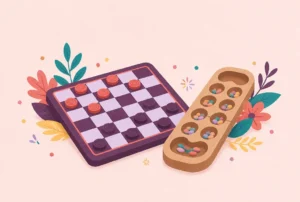
Checkers
Also called: Draughts, English draughts
Move diagonally forward, jump to capture, and crown a king when you reach the far side.
You need: An 8×8 checkerboard and 12 pieces per player. A chessboard works.
Teach it in 60 seconds
- Pieces sit on the dark squares; move one square diagonally forward.
- Jump over an opponent’s piece to capture it. If you can jump, you must.
- Reach the far row and your piece becomes a king, which can move backward too.
- Win by capturing or blocking every enemy piece.
Full rules
Setup
Place the board with a dark square in each player’s bottom-left corner. Each player puts 12 pieces on the dark squares of the three rows nearest them. The player with the darker pieces moves first.
How to play
- Take turns. An ordinary piece moves one square diagonally forward to an empty dark square.
- To capture, jump diagonally over an opponent’s piece that’s right next to yours, landing on the empty square just beyond it. Remove the jumped piece.
- If after a jump the same piece can jump again, it must keep jumping in the same turn. Multiple jumps can change direction.
- Captures are compulsory: if any jump is available, you must take one. If there’s more than one, you choose which.
- A piece that reaches the far row becomes a king: crown it with a captured piece on top. Kings move and jump diagonally forward or backward. A piece that has just been crowned ends the turn there.
How it ends
You win when your opponent can’t move, either because all their pieces are captured or because every piece is blocked. Players can also agree to a draw.
Variations and house rules
- Some casual players skip the must-jump rule. Tournament rules keep it, and the game plays better with it.
Our own wording. Rules checked against: Wikipedia; American Checker Federation, Rules of Checkers.
Chess
Each piece moves its own way. Trap the other king so it can’t escape capture, and you win. This card covers every move, including the three special ones.
You need: A chessboard and a set of 32 pieces.
Teach it in 60 seconds
- White moves first. Each piece has one way of moving; you can’t move through other pieces (except the knight).
- Capture by moving onto an enemy piece’s square.
- Attack the king and it’s check: the other player must get out of it.
- Checkmate (no way out of check) wins.
Full rules
Setup
Put the board so each player has a light square in their right-hand corner. Back row from the left: rook, knight, bishop, queen, king, bishop, knight, rook; the queen goes on her own color. All eight pawns go on the row in front.
How to play
- King: one square in any direction. Queen: any distance in a straight line, any direction. Rook: any distance along a row or column. Bishop: any distance diagonally. Knight: an L shape (two squares one way and one to the side), and it jumps over pieces.
- Pawns move one square straight forward, or two on their first move. They capture one square diagonally forward.
- Castling: once per game, if the king and a rook haven’t moved, the squares between them are empty, and the king is not in check and doesn’t pass through or land on an attacked square, move the king two squares toward the rook and put the rook on the square the king crossed.
- En passant: if a pawn moves two squares and lands beside an enemy pawn, that enemy pawn may capture it on the very next move as if it had moved only one square.
- Promotion: a pawn that reaches the far row becomes a queen, rook, bishop or knight (almost always a queen).
- You may never make a move that leaves your own king under attack.
How it ends
Checkmate wins: the king is attacked and has no legal move out of it. If the player to move has no legal move but isn’t in check, it’s stalemate, a draw. Players may also agree a draw.
Tips
- New players: learn the moves first with only pawns on the board, a game sometimes called the pawn game. First pawn to the far row wins.
Our own wording. Rules checked against: FIDE Laws of Chess; US Chess Federation, Official Rules of Chess (2026 online edition); Wikipedia.
Backgammon
A race around the board with a fighting edge. Move all 15 of your checkers home and bear them off before your opponent does.
You need: A backgammon board, 15 checkers per player and two dice each (one pair is enough).
Teach it in 60 seconds
- Roll two dice and move checkers by each number. Doubles move four times.
- You can’t land on a point with two or more enemy checkers. Land on a single enemy checker and you hit it to the bar.
- A hit checker must come back in from the start before you move anything else.
- Bring all 15 home, then bear them off. First off wins.
Full rules
Setup
The board has 24 narrow triangles called points, numbered from each player’s own point of view. Each player places 2 checkers on their 24-point, 5 on their 13-point, 3 on their 8-point and 5 on their 6-point. You move your checkers from your 24-point toward your 1-point; your opponent moves the opposite way. Your home board is points 1 to 6.
How to play
- To start, each player rolls one die. The higher roller moves first, using both of those numbers.
- Then take turns rolling two dice. Move one checker the number on one die and another (or the same) checker the number on the other. Each number is a separate move.
- Doubles are played four times: double 3 means four moves of 3.
- You may land on any point that is empty, holds your own checkers, or holds exactly one enemy checker. A point with two or more enemy checkers is blocked.
- Landing on a lone enemy checker (a blot) hits it: put it on the bar in the middle. A player with a checker on the bar must bring it back in, on the opponent’s home board, before moving anything else. If the entry points are blocked, they lose the turn.
- You must use both numbers if you legally can. If only one can be used, use it; if either but not both, use the larger.
- Once all 15 of your checkers are in your home board, you may bear off: remove a checker from the point matching a die. A higher number may bear off from the highest occupied point if no checker sits on that exact point or higher.
Scoring
- Single win: the first player to bear off all 15.
- Gammon (2 points): the loser hasn’t borne off any checkers.
- Backgammon (3 points): the loser hasn’t borne off any and still has a checker on the bar or in the winner’s home board.
How it ends
Play to an agreed number of points, often 5 or 7. The doubling cube (for raising the stakes during a game) is optional and can wait until everyone knows the basics.
Our own wording. Rules checked against: Backgammon Galore (bkgm.com), Rules of Backgammon; US Backgammon Federation, Backgammon Basics; Wikipedia.
Mancala
Also called: the two-row store-and-capture version
Scoop up the stones from one pit and sow them one by one around the board. The most stones in your store at the end wins.
You need: A mancala board (two rows of six pits plus a store at each end) and 48 stones. An egg carton and two bowls work.
Teach it in 60 seconds
- Four stones in each of the 12 pits. Your store is at your right-hand end.
- Pick up all stones in one of your pits and drop one in each pit counterclockwise, including your store, skipping your opponent’s.
- Last stone in your store? Go again. Last stone in an empty pit on your side? Capture it and the stones opposite.
- When one side is empty, the game ends. Most stones wins.
Full rules
Setup
Put the board between you with its long side facing you. The six pits on your side are yours, and the store at your right-hand end is yours. Put four stones in each of the twelve pits.
How to play
- On your turn, pick up all the stones from any one pit on your side.
- Moving counterclockwise, drop one stone into each pit in turn, including your own store but skipping your opponent’s store.
- If your last stone lands in your store, take another turn.
- If your last stone lands in an empty pit on your side and the pit directly opposite holds stones, capture: move that last stone and all the stones opposite into your store.
- The game ends when all six pits on one side are empty. The other player moves the stones left on their side into their own store.
How it ends
The player with more stones in their store wins.
Variations and house rules
- Mancala is a whole family of games played across Africa, Asia and the Americas, with hundreds of traditional rule sets. The rules here are the version most US boxed sets include.
- Some sets start with three stones per pit for a shorter game. Some rules allow a capture even when the opposite pit is empty.
Tips
- Counting out loud while sowing makes this a good math game for young children.
Our own wording. Rules checked against: Wikipedia; Mancala World wiki, Kalah.
Nine Men's Morris
Also called: Mill, Merrills
A Roman-era strategy game. Make a row of three, a mill, and you take one of your opponent’s pieces.
You need: A morris board (draw one: three nested squares joined at the midpoints) and nine coins or counters each in two colors.
Teach it in 60 seconds
- Take turns placing your nine pieces on empty points.
- Three of yours in a straight line is a mill: remove one enemy piece.
- Once all are placed, slide a piece along a line to the next empty point. Mills still capture.
- Win when your opponent has only two pieces or can’t move.
Full rules
Setup
Draw the board: three squares, one inside the other, with lines joining the midpoints of their sides. That gives 24 points where lines meet or end. Each player has nine pieces.
How to play
- Placing: take turns putting one piece on any empty point.
- Whenever you make a mill (three of your pieces in a straight line along one of the drawn lines), remove one of your opponent’s pieces from the board. You may not take a piece that is in a mill unless every one of their pieces is in a mill.
- Moving: when all 18 pieces are placed, take turns sliding one of your pieces along a line to an adjacent empty point. Making a mill still captures.
- You may open a mill by moving a piece out and then close it again on a later turn to capture again.
- Flying: when a player is down to three pieces, many rule sets let that player move a piece to any empty point, not just an adjacent one.
How it ends
You lose when you’re down to two pieces, or when it’s your turn and you have no legal move.
Tips
- The board is easy to draw on paper or on a sidewalk in chalk, and the game has been found carved into old buildings across Europe.
Our own wording. Rules checked against: Wikipedia; BoardGameGeek, Nine Men's Morris.
Chinese Checkers
Also called: Sternhalma, Star Halma
Race your marbles across the star into the opposite point. Hop over any marble, yours or anyone’s, and chain hops together.
You need: A six-pointed star board and 10 marbles per player in different colors.
Teach it in 60 seconds
- Fill your star point with your 10 marbles.
- On your turn move one marble to a neighboring hole, or hop over one marble into the empty hole beyond.
- Hops can chain as far as you can keep hopping.
- First to fill the point across the board wins.
Full rules
Setup
Each player fills one point of the star with 10 marbles. Two players use opposite points; three use every other point; four, six use pairs of opposite points.
How to play
- Take turns moving one marble.
- A step moves a marble into an adjacent empty hole, in any direction.
- A hop jumps over one adjacent marble (any color) into the empty hole directly beyond it. You may keep hopping with the same marble as long as more hops are open, changing direction as you go. You can’t combine a step and hops in the same turn.
- Nothing is captured. Hopped marbles stay where they are.
How it ends
The first player to move all 10 marbles into the point directly opposite their start wins. Others can keep playing for second place.
Variations and house rules
- Some groups forbid parking a marble in your own home point to block others late in the game.
Tips
- The name is a 1928 American marketing invention. The game itself is Stern-Halma, invented in Germany in 1892 as a star-board version of the American game Halma.
Our own wording. Rules checked against: Wikipedia; BoardGameGeek, Chinese Checkers.
Pencil and paper games 5 games
Nothing to buy. A pencil, scrap paper and sometimes a timer.
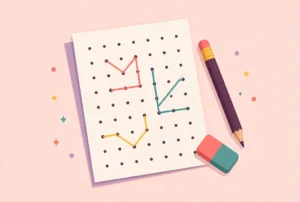
Dots and Boxes
Also called: Boxes, Pigs in a Pen
Take turns joining dots. Close the fourth side of a box and you claim it and go again.
You need: Paper and a pencil.
Teach it in 60 seconds
- Draw a grid of dots, about 6 by 6.
- On your turn, draw one line joining two neighboring dots, across or down.
- Close a box? Write your initial in it and draw another line.
- When every box is claimed, most boxes wins.
Full rules
Setup
Draw a rectangular grid of dots. Five by five dots (16 boxes) is quick; larger grids make for a longer, more strategic game.
How to play
- Take turns drawing a single straight line between two dots that are next to each other, horizontally or vertically. No diagonals.
- If your line completes the fourth side of a box, write your initial inside it and take another turn. You must keep drawing as long as you complete boxes.
- A single line can complete two boxes at once.
How it ends
When all boxes are claimed, the player with the most wins.
Tips
- Strategy tip for older kids: avoid drawing the third side of a box; it hands your opponent a free point.
Our own wording. Rules checked against: Wikipedia; Berlekamp, The Dots and Boxes Game (A K Peters, 2000).
Hangman
Also called: Snowman, Spaceman (classroom versions)
One player thinks of a word and shows only blanks. Others guess letters before a picture is finished.
You need: Paper or a whiteboard and a pen.
Teach it in 60 seconds
- Pick a secret word and draw one blank per letter.
- Guessers call out one letter at a time.
- Right letter: write it in every blank where it appears. Wrong letter: add a part to the drawing.
- Guess the word before the drawing is done.
Full rules
Setup
The chooser picks a word or phrase and draws a dash for each letter. Agree how many wrong guesses are allowed, usually six or more, each one adding a part to a drawing.
How to play
- Guessers call out a letter.
- If it’s in the word, the chooser writes it in every place it appears.
- If it isn’t, the chooser writes it to the side (so nobody repeats it) and draws one part of the picture.
- A guesser may try for the whole word at any time. A wrong whole-word guess costs one part.
How it ends
The guessers win if they complete the word before the drawing is finished. Otherwise the chooser wins and reveals the word. Whoever solved it chooses next.
Variations and house rules
- Many teachers draw a snowman melting or a rocket being built instead of a gallows. The game works the same.
Tips
- Use spelling-list words, vocabulary words or names from a book the class is reading.
Our own wording. Rules checked against: Wikipedia; Merriam-Webster, Word Games: hangman.
Sea Battle
Also called: Battleships (pencil and paper)
The pencil-and-paper naval guessing game played long before the plastic boxed versions. Hide your fleet and sink your opponent’s by calling grid squares.
You need: Graph paper (or our printable grids) and a pencil for each player.
Teach it in 60 seconds
- Each player draws two 10×10 grids: one for their fleet, one for their shots.
- Secretly mark ships of 5, 4, 3, 3 and 2 squares, in straight lines.
- Take turns calling a square, like C7. The other player says hit or miss.
- Sink every ship to win.
Full rules
Setup
Each player draws two 10 by 10 grids, with letters A to J down the side and numbers 1 to 10 across the top. On the first grid, secretly mark your fleet: one ship 5 squares long, one 4, two 3s and one 2. Ships run straight across or down and may not overlap.
How to play
- Take turns calling one square: “B4.”
- The other player answers “hit” or “miss” honestly. When every square of a ship has been hit, they say “sunk” and which ship.
- Mark your shots on your second grid: an X for a hit, a dot for a miss.
How it ends
The first player to sink the whole enemy fleet wins.
Variations and house rules
- Salvo: fire one shot for each of your ships still afloat, all called at once, then hear the results.
- Older paper versions used different fleets. Any fleet works as long as both players use the same one.
Tips
- A sneaky way to practice coordinates in math class.
Our own wording. Rules checked against: Wikipedia; BoardGameGeek, Battleship (pencil and paper).
Categories
Also called: Guggenheim, Stadt Land Fluss, the letter-and-category game
Pick a letter. Everyone races to write something in each category that starts with it. Answers nobody else thought of score double.
You need: Paper, pencils and a timer.
Teach it in 60 seconds
- Agree on 6 to 10 categories: a city, an animal, a food, a name…
- Pick a random letter and start a 2-minute timer.
- Write one answer per category beginning with that letter.
- Unique answers score 2, shared answers 1. Most points wins.
Full rules
Setup
Agree on a list of categories (for example: a boy’s name, a girl’s name, a country, an animal, a food, a thing in this room, a TV show, a job). Each player writes them down the left side of a page.
How to play
- Choose a letter at random: open a book to any page and use the first letter, or call one from the alphabet. Skip hard letters like Q, X and Z, or keep them for the brave.
- Start a timer, usually two or three minutes. Everyone writes one answer per category beginning with that letter.
- When time’s up, go around and read answers aloud, one category at a time.
- A unique answer scores 2 points; an answer someone else also wrote scores 1. The group can veto an answer that doesn’t fit.
How it ends
Play a set number of rounds with new letters. Highest total wins.
Variations and house rules
- Guggenheim, the older parlor version: write a short key word across the top of a grid and categories down the side, and fill every square with an answer starting with the letter at the top of its column.
Our own wording. Rules checked against: Wikipedia; The Christian Science Monitor, “Rainy-day games that run on paper, paste and imagination” (1981).
Paper Telephone
Also called: Picture Telephone, Eat Poop You Cat
A sentence turns into a drawing, then back into a sentence, then a drawing, as it travels around the table. The reveal at the end is the whole point.
You need: A small stack of paper strips or a booklet for each player, and pencils.
Teach it in 60 seconds
- Everyone writes a short sentence at the top of their paper.
- Pass it on. The next player draws a picture of it and folds the sentence out of sight.
- Pass again. The next player writes what the drawing shows and folds the drawing away.
- Keep alternating until it comes home, then read them all out.
Full rules
Setup
Each player gets a strip of paper long enough for one line per player, or a small booklet.
How to play
- Everyone writes a sentence or phrase at the top. Something you can draw, like “a cat running for mayor.”
- Pass the paper to the left. Read the sentence, draw it below, then fold the paper so only your drawing shows.
- Pass again. The next player looks at the drawing only, writes a sentence describing it, and folds the drawing out of sight.
- Keep passing, alternating drawing and writing, until each paper returns to the player who started it.
How it ends
Unfold the papers one at a time and read them aloud from top to bottom. Nobody wins; everybody laughs.
Tips
- Stick figures are fine. Bad drawing makes the game better.
Our own wording. Rules checked against: Wikipedia; BoardGameGeek, Eat Poop You Cat.
Parlor and party games 9 games
Old word, acting and guessing games for a room full of people. Most need nothing at all.
Charades
Act out a title or phrase without speaking while your team guesses against the clock.
You need: Slips of paper with titles or phrases, a bowl and a timer.
Teach it in 60 seconds
- Split into two teams. Each team writes titles for the other team to act.
- One player draws a slip and acts it out in silence.
- Use the standard signs: category, number of words, syllables, “sounds like.”
- Teammates guess before the timer runs out.
Full rules
Setup
Split into two teams. Each team writes book, movie, song or TV titles (or common phrases) on slips and puts them in a bowl for the other team.
How to play
- A player from the acting team draws a slip from the other team’s bowl and has a moment to read it.
- Start a timer, usually two or three minutes. The player acts it out without speaking or mouthing words, and teammates call out guesses.
- Standard signs: show the category (open hands like a book, crank an old movie camera for a movie, sing for a song, draw a box for TV); hold up fingers for the number of words; then fingers again for which word you’re acting.
- Lay fingers on your forearm for the number of syllables. Tug your earlobe for “sounds like.” Pinch finger and thumb for a small word, like “a” or “the.”
- When someone guesses right, point at them and touch your nose. Note how long it took. Then the other team takes a turn.
How it ends
After everyone has acted, the team with the lowest total time (or the most correct guesses) wins.
Variations and house rules
- For kids, use animals, jobs or everyday actions instead of titles.
- Seated version: act with hands and face only, which works well for groups with limited mobility.
Our own wording. Rules checked against: Wikipedia; Cassell's Book of In-door Amusements, Card Games and Fireside Fun (1881), Project Gutenberg.
Twenty Questions
Also called: Animal, Vegetable or Mineral
One person thinks of something. Everyone else has twenty yes-or-no questions to work out what it is.
You need: Nothing. A pencil to count questions helps.
Teach it in 60 seconds
- One player thinks of an object, animal, person or place.
- Others ask yes-or-no questions, twenty in all.
- A classic opener: “Is it animal, vegetable or mineral?”
- Guess it within twenty and the guessers win.
Full rules
Setup
Pick a player to think of something. Someone keeps count of questions.
How to play
- The other players take turns asking questions that can be answered yes or no.
- The answerer replies honestly: yes, no, or “sometimes” or “I don’t know” if it truly isn’t clear.
- Any question can be a guess: “Is it a giraffe?” A guess counts as a question.
- The traditional first question is whether the thing is animal (a living creature or something made from one), vegetable (plant) or mineral (everything else).
How it ends
If someone guesses correctly within 20 questions, they think of the next thing. If nobody does, the answerer wins and goes again.
Tips
- Great for car trips and waiting rooms. Ask kids to tell you afterward which question helped most.
Our own wording. Rules checked against: Wikipedia; Merriam-Webster, twenty questions.
Botticelli
A tricky Twenty Questions for people who like trivia. One player is a famous person; everyone else earns the right to ask questions by stumping them.
You need: Nothing.
Teach it in 60 seconds
- The chooser picks a famous person and gives the first letter of the last name.
- Guessers ask “Are you a…?” clues about someone else with that letter.
- The chooser must name who you mean. If they can’t, you get a direct yes-or-no question.
- Work out who the chooser is.
Full rules
Setup
One player, the chooser, secretly picks a well-known person, real or fictional, and announces the first letter of their last name. Say it’s B.
How to play
- Guessers take turns asking indirect questions about any person with that initial: “Are you a famous composer?”
- The chooser must name a person who fits but isn’t their secret identity: “No, I’m not Beethoven.” Then the next guesser asks.
- If the chooser can’t think of anyone who fits, the guesser who asked earns a direct yes-or-no question about the secret person: “Are you alive?”
- The chooser must answer direct questions truthfully.
- Guessers may name the secret person at any time on their turn.
How it ends
Whoever guesses the secret person correctly becomes the next chooser.
Tips
- Agree beforehand on how famous a person has to be. It saves arguments.
Our own wording. Rules checked against: Wikipedia; QBWiki, Botticelli.
Wink Murder
Also called: Murder Wink, Killer
One player is secretly the murderer and kills by winking. The detective has to spot who it is before everyone’s gone.
You need: Slips of paper or playing cards to assign roles secretly.
Teach it in 60 seconds
- Secretly choose one murderer and one detective. The detective is announced.
- Everyone mills around or sits in a circle making eye contact.
- The murderer kills by winking. Victims wait a few seconds, then die dramatically.
- The detective has three guesses to name the murderer.
Full rules
Setup
Deal cards or slips so one player is the murderer (say, the ace of spades) and one is the detective (the king of hearts). The detective reveals themselves; the murderer stays secret. Everyone else is a townsperson.
How to play
- Players sit in a circle or walk around the room, looking each other in the eye.
- The murderer kills a player by winking at them. A victim counts silently to five, then dies as dramatically as they like and sits out.
- The detective watches and may accuse someone at any time. They get three guesses.
- If a townsperson thinks they’ve seen the wink, they can’t say so, unless your group plays the version where townspeople may make accusations too.
How it ends
The detective wins by naming the murderer. The murderer wins by killing everyone, or if the detective uses up all their guesses.
Variations and house rules
- No detective: anyone may accuse, and a wrong accusation knocks the accuser out.
- Swap the wink for a handshake squeeze or a stuck-out tongue for younger kids.
Tips
- Good for classrooms and youth groups because it can be played seated. Adjust the theme if “murder” doesn’t suit your group: call it Sleepy Wink.
Our own wording. Rules checked against: Wikipedia; Scouts (UK), Wink murder activity.
Sardines
Also called: Reverse hide-and-seek
Hide-and-seek in reverse. One player hides and everyone seeks. When you find the hider, you squeeze in and hide with them.
You need: A house or building with places to hide.
Teach it in 60 seconds
- One player hides while everyone else counts.
- Everyone splits up and searches on their own.
- Find the hider? Don’t say anything. Squeeze in and hide with them.
- The last seeker left becomes the next hider.
Full rules
Setup
Agree on the boundaries: which rooms are in play and which are off limits. One player is the hider.
How to play
- Everyone else counts to 100 together, eyes closed, while the hider hides somewhere big enough for a crowd.
- Seekers split up and search separately.
- When a seeker finds the hider, they quietly join them in the hiding place, without alerting anyone.
- The hiding place gets more and more crowded, and harder to keep quiet.
How it ends
The game ends when the last seeker finds the group. That player hides first in the next round.
Tips
- Mark off-limits rooms and anything dangerous (closets with chemicals, appliances, stairs in the dark) before you start. Agree on a call that ends the game at once.
Our own wording. Rules checked against: Wikipedia; Playworks, Sardines.
Fishbowl
Also called: Celebrity, Salad Bowl, the hat game
Everyone writes names into a bowl. Teams guess the same names three times: first with any words, then one word only, then acting.
You need: Slips of paper, pens, a bowl and a timer.
Teach it in 60 seconds
- Everyone writes 3 to 5 names (famous people, characters, things) on slips. Into the bowl.
- Round 1: describe as many as you can in a minute, without saying the name.
- Round 2: same slips, but only one word as a clue. Round 3: acting only.
- Each correct guess is a point. Most points after three rounds wins.
Full rules
Setup
Split into two teams sitting alternately. Each player writes three to five names on separate slips and folds them into the bowl.
How to play
- Teams take turns. One player from the active team draws slips and gives clues for one minute. Teammates guess. A correct guess wins the slip and the clue-giver draws another.
- Round 1: any words allowed, except the name itself or parts of it.
- Round 2: put every slip back. Now the clue-giver may say just one word per name.
- Round 3: back in the bowl again. Clues are acting only, no words.
- A round ends when the bowl is empty. Many groups let a turn in progress carry its leftover time into the next round.
How it ends
Count slips won across the three rounds. The team with more wins.
Tips
- Because the names repeat, round 3 turns into a pile of in-jokes. Write things your group knows.
Our own wording. Rules checked against: Wikipedia; Your Teen Magazine, How to Play the Fishbowl Game.
Ghost
Also called: the spelling game
Players add one letter at a time to a growing word fragment. Finish a word, or bluff into a dead end, and you collect a letter of G-H-O-S-T.
You need: Nothing. A dictionary for disputes.
Teach it in 60 seconds
- Take turns saying one letter, building toward a real word.
- Don’t be the one who completes a word of four or more letters.
- Think the last player has no real word in mind? Challenge them.
- Each loss earns a letter of G-H-O-S-T. Spell it and you’re out.
Full rules
Setup
Sit in a circle. No equipment.
How to play
- The first player says a letter. Each player in turn adds one letter to the end, so the letters always spell the beginning of a real word.
- If you complete a word of four or more letters, you lose the round, even if a longer word could continue.
- Instead of adding a letter, you may challenge the previous player if you think no word starts with those letters. They must name a real word. If they can, you lose the round; if they can’t, they lose it.
How it ends
Losing a round earns one letter of G-H-O-S-T. Spell the whole word and you become a ghost and are out. The last player left wins.
Variations and house rules
- Superghost: letters may be added to either end.
Our own wording. Rules checked against: Wikipedia; UC Berkeley GamesCrafters, Ghost.
Who Am I?
Also called: Headbands, the sticky-note game
A name is stuck on your forehead where you can’t see it. Ask yes-or-no questions to work out who you are.
You need: Sticky notes and a marker.
Teach it in 60 seconds
- Write a famous name (or animal, or object) on a sticky note for your neighbor without letting them see.
- Stick it on their forehead or back.
- Take turns asking yes-or-no questions about yourself.
- First to guess who they are wins, but keep playing until everyone has it.
Full rules
Setup
Each player writes a name for the player on their left and sticks it on that player’s forehead (or back, for a mingling game).
How to play
- On your turn, ask one yes-or-no question about the name on your head: “Am I a real person?” “Am I alive?”
- If the answer is yes, ask another. If no, the turn passes.
- Guess any time on your turn. A wrong guess ends your turn.
How it ends
Players drop out as they guess correctly. The first to guess wins; the game ends when everyone has their answer.
Variations and house rules
- Mixer version for big groups: stick names on backs and let people wander, asking each person one question.
Tips
- Pick names that suit the group. Book characters work for classrooms; past presidents or old film stars suit a senior center.
Our own wording. Rules checked against: Scouts (UK), Who am I? activity; Game On Family, How to Play the Who Am I Game.
Telephone
Also called: Grapevine, Gossip, Chinese Whispers (UK name)
Whisper a message down a line and see how much it changes by the end.
You need: Nothing.
Teach it in 60 seconds
- Sit or stand in a line or circle.
- The first player whispers a sentence to the next, once.
- Each player whispers what they heard to the next.
- The last player says it out loud. Compare it with the original.
Full rules
Setup
Players sit or stand in a line or circle, close enough to whisper.
How to play
- The first player thinks of a sentence, or reads one from a card, and whispers it to the next player.
- Each player whispers what they heard to the next. No repeats: say it once.
- The last player says the message out loud. Then the first player says the original.
How it ends
No winner. Talk about where it changed, which is useful in classrooms for talking about rumors and listening.
Tips
- For hearing-impaired players, try a version where the message is drawn on each person’s back with a fingertip, or passed as a gesture.
Our own wording. Rules checked against: Wikipedia; Playworks, Telephone/Rumor.
What can we play with what’s in the drawer?
The quick version of the finder. Most homes have at least one of these.
| One deck of cards | War, Slapjack, Concentration, Go Fish, Old Maid, Crazy Eights, Spoons, Speed, I Doubt It, Rummy, Gin Rummy, Kings in the Corner, Hearts, Spades, Euchre, Oh Hell, Cribbage |
|---|---|
| A set of dominoes | Block Dominoes, Draw Dominoes, Muggins, Mexican Train |
| A few dice | Pig, Liar's Dice, Yacht, Ten Thousand, Ship, Captain and Crew, Bunco, Beetle, Backgammon |
| A board game set | Checkers, Chess, Backgammon, Mancala, Nine Men's Morris, Chinese Checkers |
| Paper and a pencil | Beetle, Dots and Boxes, Hangman, Sea Battle, Categories, Paper Telephone, Charades, Wink Murder, Fishbowl, Who Am I? |
| Nothing at all | Twenty Questions, Botticelli, Sardines, Ghost, Telephone |
Printable score sheets and boards
Lost the score pad that came with the box? These print on US Letter or A4 (use the paper setting under Rule cards). All six together: score sheets PDF.
Yacht score sheet
All 12 boxes with the scoring rules printed beside them, six player columns.
Bunco score sheets
A table score pad and a personal tally sheet for wins, losses and Buncos, four per page.
Mexican Train score sheet
Thirteen rounds from 12-12 down to 0-0, eight players, with a line for your house rules.
Card game score pad
Running totals for six players over 20 hands. Works for Hearts, Spades, Rummy, Oh Hell and Ten Thousand.
Sea Battle grids
Two 10×10 grids per player (your fleet and your shots), two players per page.
Dots, morris and categories
A dots-and-boxes grid, a Nine Men's Morris board and a categories answer sheet on one page.
Printable rule cards
Each game prints as a rule card with the 60-second version at the top and the full rules below. Standard cards fit two to a page where the rules are short; large print puts one game per page in bigger type. Cards are built in your browser and nothing is uploaded.
Ready-made PDFs of all 48 games: US Letter · A4 · Large print (Letter). Print at 100% (“Actual size”). More help: printing tips.
House rules, kids and accessible play
Almost every family plays some game “wrong.” That’s fine as long as everyone at the table agrees before the first card is dealt. Write your house rules on the back of the printed card and keep it in the box.
Low vision
Print the large-print cards. Jumbo-index playing cards, dominoes with raised or large pips, and big-dot dice are easy to find and change the game for many older players. Good light matters more than you’d think.
Color blindness
Our rule cards never rely on color alone: every rule is in words. For card games where red and black matter (Kings in the Corner), a four-color deck, with clubs green and diamonds blue, helps.
Younger children
Play with open hands for the first game, drop the scoring, and use the “Teach it in 60 seconds” box as the whole rulebook. Concentration with 10 pairs, War, Go Fish, Pig and Beetle all work from about age four to six.
Hands and mobility
A card holder (or a shoebox lid with a slot cut in it) helps anyone who finds it hard to fan cards. Slap and grab games (Slapjack, Spoons) have gentler versions in their entries.
Memory and attention
Short, familiar games with no hidden scoring, like Block Dominoes, War, Ship, Captain and Crew and Twenty Questions, are favorites in senior-center activity programs. Our printable games for seniors are large print too.
Settling arguments
When a rule is disputed, read the full rules entry out loud, then agree on a house rule and write it down. Pagat.com, linked under each card game, documents regional variations in more depth than any rulebook.
For libraries, schools and game clubs
No ads, no sign-up, no email wall. Free to print and copy.
Lending games? Print the rule card for each game you circulate and tape it inside the box lid, or link to a single game from your catalog record or LibGuide. To cite this page:
Party Game Book Editors. (2026). How to play: Free rules for classic card, domino, dice, board and parlor games. Party Game Book. https://partygamebook.com/how-to-play/
Party Game Book Editors. “How to Play: Free Rules for Classic Card, Domino, Dice, Board and Parlor Games.” Party Game Book, 2026, partygamebook.com/how-to-play/.
Every game has its own address, for example partygamebook.com/how-to-play/#mexican-train
- 48 games in six sections, each with a 60-second summary, full rules, scoring, common house rules and a printable card.
- Our own wording. These are traditional and public-domain games, written up from scratch. No rule text is copied from any rulebook or website, and we use generic names only.
- Checked against two published sources per game, linked in each entry. Where sources disagree, we say so and give the common version.
- Last reviewed: October 2026. Spot a mistake, or play it differently where you live? Email hello@partygamebook.com.
Sources and further reading
- John McLeod, Pagat.com: Card Game Rules, the standard reference for card and domino games and their regional variations.
- Bicycle Playing Cards, How to Play card games.
- FIDE, Laws of Chess, and US Chess Federation, uschess.org.
- American Checker Federation, Rules of checkers.
- US Backgammon Federation, usbgf.org.
- Cassell’s Book of In-door Amusements, Card Games and Fireside Fun (1881), free at Project Gutenberg, for the older parlor games.
- Playworks, Game Library, for playground and classroom versions.
- Each game entry lists the two sources its rules were checked against.
More free games from Party Game Book
- Game night ideas for adultsThemes, food and a running order for the evening.
- Printable games for seniorsLarge-print sheets for activity programs.
- The Group Games Library56 icebreakers, energizers and team games with printable cards.
- Would you rather questionsHundreds of prompts, including a kids’ list.
- Survey game questionsA team guessing game for big groups.
- The Game MakerMake and print your own bingo, trivia and more.
0 cards