55 games for youth groups, Sunday school and church events: big-room games, small-group games for nights when only three kids show up, up-front stage games, water games, messy games, night games, games with a point and Bible games for children. Filter by group size, age, space, time, energy and mess. Every game lists setup, rules, safety notes and leader tips, and prints as a game card.
- No ads
- No sign-up or email
- Free to print and copy for your ministry
Non-denominational. Bible references are given so you can read the passage yourself.
Game finder
Pick what you know about your group and your space. Every filter is optional, and the results update as you go.
No games match all of those filters. Try removing one.
Big-room games 8 games
Games for the gym or fellowship hall when 20 or more kids show up. Clear the chairs to the walls, tape a few lines, and keep an adult on each side of the room.
Elimination Dodgeball (Soft-Ball Version)
Also called: Dodgeball, Bombardment
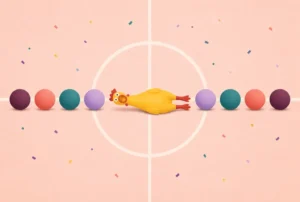
Two teams throw soft foam balls across a center line; a hit sends you to the sideline, and a catch brings a teammate back in.
How to play
You need
4 to 8 soft foam balls, tape or cones for a center line and a neutral zone.
Setup
Tape a center line across the gym, plus a second line 5 feet out on each side of it. That 10-foot neutral zone is off-limits for everyone. Line the foam balls up on the center line.
How to play
- Both teams start against their back wall. On “go,” players may run up to grab balls, but only to the edge of the neutral zone.
- Throw from behind the neutral-zone line. A ball that hits a player below the shoulders on the fly sends that player to the sideline.
- If you catch a thrown ball, the thrower goes to the sideline and the first player waiting on your sideline comes back in.
- Hits off the floor, wall or ceiling don’t count. Neither do head shots; a head shot sends the thrower to the sideline instead.
- The round ends when one team is empty or after five minutes. Start a fresh round with everyone back in.
Safety notes
- Soft foam balls only. No playground balls, volleyballs or basketballs, at any age.
- The neutral zone keeps every throw at a decent distance. Nobody throws from inside it.
- Split very mixed ages into separate games, or give younger players a side court.
Leader tips
- Keep rounds short so the kids who get hit early are back in quickly. Nobody should spend 20 minutes on a bench.
- Put a leader on each sideline to call hits; arguments are the real danger in this game.
- Add a ball every round or two if it slows down.
Variations
- Medic version: each team names a secret medic who can tap hit players back in. Hit the medic and the healing stops.
- Pin version: each team guards three plastic bowling pins at its back wall. Knock all three down to win.
Rubber Chicken Tag
Also called: Chicken Safe Tag
A tag game where holding the rubber chicken makes you safe, but you only get to hold it for five seconds.
How to play
You need
1 or 2 rubber chickens, pinnies or bandanas for taggers.
Setup
Mark boundaries. Pick two or three taggers and give them pinnies. Hand a rubber chicken to any other player.
How to play
- Taggers chase everyone else. A tagged player freezes with arms out.
- Whoever is holding the rubber chicken can’t be tagged.
- You may hold the chicken for a slow count of five, then you must toss it to someone else. A tagger can’t catch it.
- Free players unfreeze a frozen friend by handing them the chicken.
- Swap taggers every two or three minutes.
Safety notes
- Tosses are underhand and soft. The chicken is rubber, but a face shot still stings.
- No snatching the chicken out of someone’s hands.
Leader tips
- The squawk is half the fun. Buy the kind that squeaks if you can find it.
- With a big crowd, add a second chicken and a fourth tagger.
Rubber Chicken Rounders
Also called: Chuck the Chicken, Chicken Baseball
One team chucks a rubber chicken and runs laps around its own huddle; the other team races to the chicken and passes it down a line to stop the runner.
How to play
You need
A rubber chicken.
Setup
Split into two teams. The throwing team huddles in a tight group in the middle of the space. The fielding team spreads out anywhere.
How to play
- One player on the throwing team hurls the chicken as far as they like, then runs laps around their own huddle. Their teammates count the laps out loud.
- The fielding team runs to wherever the chicken landed and lines up single file behind the first player to reach it.
- They pass the chicken back over the head of the first player, between the legs of the second, over the next, and so on to the end.
- When the last player in line gets it, they hold it up and shout “Chicken.” The runner stops, and the laps count as points.
- Everyone on the throwing team takes a turn, then the teams switch.
Safety notes
- Throw away from walls, lights and windows. Indoors, aim for the far end of the gym, not the ceiling.
- The huddle stays tight so the runner isn’t weaving through people.
Leader tips
- Adults and leaders can play this one too; it’s mostly about lining up fast, not about being athletic.
- If a team has a strong arm, add a rule that the thrower must throw with their wrong hand.
The Big Wind Blows
Also called: Concentric Circles, Fruit Basket
A circle game where the player in the middle calls out a trait, and everyone who shares it scrambles for a new spot while the caller grabs one too.
How to play
You need
One tape X or poly spot per player, minus one.
Setup
Mark a big circle of spots on the floor, one fewer than the number of players. Everyone stands on a spot except the caller in the middle.
How to play
- The caller says “The big wind blows for everyone who” and finishes it with something true about themselves: “has a dog,” “was born in another state,” “skipped breakfast.”
- Everyone that applies to must leave their spot and find a new one at least two spots away.
- The caller also races for a spot. Whoever ends up without one is the next caller.
- If the caller says “Hurricane,” everyone moves.
Safety notes
- Use floor spots rather than chairs for teens; diving into chairs is how this game hurts people.
- Walking pace if the floor is slick, and no shoulder-checking to win a spot.
Leader tips
- It doubles as a get-to-know-you game. Listen for what kids call out; you’ll learn a lot about the group.
- Make a rule that you can’t call the same trait twice in a night.
Ninja
Also called: Ninja Slap
Players stand in a circle and take turns making one quick move to tap another player’s hand; a tapped hand goes behind your back.
How to play
Setup
Everyone stands in a circle, close enough to reach a neighbor. On a count of three, everyone jumps back into a frozen ninja pose.
How to play
- Going around the circle, each player gets one move: a single motion, like a step and a swipe, aimed at someone’s hand.
- The target may make one move to dodge. Then both freeze where they are.
- If your hand gets tapped, that hand goes behind your back. Lose both and you sit out until the next round.
- Play continues around the circle until two players are left; they face off in a final.
Safety notes
- Taps only, on the hand from the wrist down. No slapping arms or faces.
- With 20 or more, run two circles so nobody waits long on the sidelines.
Leader tips
- Freezing is the whole game. Call players out for extra wiggles and the tension goes way up.
- Leaders who join in make it easier for shy kids to jump in.
Sardines
Also called: Reverse Hide and Seek
One player hides and everyone else searches; when you find the hider, you quietly squeeze in with them until the last searcher finds the whole packed group.
How to play
Setup
Pick the rooms that are in play and close off the rest. Post adults at the edges of the area, and choose one hider.
How to play
- The hider gets two minutes to hide while everyone else waits in the main room.
- Searchers split up and look. When you find the hider, don’t announce it. Quietly join them in the hiding spot.
- The hiding spot gets more and more crowded, and harder to keep quiet.
- The last searcher to find the group is the next hider.
Safety notes
- Follow your church’s child protection policy: rooms in play stay unlocked with doors open, and no hiding spot puts one adult alone with a child.
- Off limits: the sanctuary platform, kitchens, closets with chemicals, stairwells and anywhere outside.
- Do a headcount when each round ends.
Leader tips
- Play with the lights on the first time. Dimmed hall lights make it spookier once the group knows the rules.
- Send searchers in pairs if your building is big.
Four Corners
Players tiptoe to one of four numbered corners while the caller’s eyes are closed; the caller picks a corner, and the players there sit out.
How to play
You need
Four signs numbered 1 to 4.
Setup
Tape a number sign in each corner of the room. Pick a caller to stand in the middle with eyes closed.
How to play
- The caller counts down slowly from ten while everyone else walks to a corner.
- At zero, everyone must be in a corner. The caller, eyes still closed, calls a number.
- Players in that corner sit down in the middle of the room as helpers. On the next round, helpers whisper a number to the caller.
- Keep going until one player is left. They’re the next caller.
Safety notes
- Walking only. Corners fill up fast and running into a wall is easy to do.
Leader tips
- A fast game to start a night while kids are still arriving. Latecomers just join the next round.
- Rename the corners for the night: four books of the Bible, four countries, four snack foods.
Wrong Holiday Relay
Also called: Absurd Holiday Games, Christmas in July
A relay where every leg is a holiday done in the wrong season or the wrong way: wrap a teammate like a present, carry an egg on a spoon around a pumpkin, write a valentine to a turkey.
How to play
You need
Wrapping paper and tape, plastic eggs and spoons, a few plastic pumpkins, paper hearts and markers, a mismatched hat for each team.
Setup
Set up four stations in a loop around the room. Split into teams of five or six. Each team picks one player to be the “gift.”
How to play
- Station one: wrap the team’s gift player in wrapping paper, head and face left free, in 60 seconds.
- Station two: one runner carries a plastic egg on a spoon around a plastic pumpkin and back.
- Station three: one runner writes a sweet valentine to a holiday character of the team’s choice, like a turkey or a snowman, and reads it out loud.
- Station four: the whole team puts on the mismatched hat one at a time and sings two lines of any holiday song together, wrong season on purpose.
- First team to finish all four stations with a fully wrapped gift wins.
Safety notes
- Never wrap anyone’s face, neck or hands, and keep tape off skin and hair.
- The wrapped player walks, never runs, and a teammate stays at their elbow.
Leader tips
- Schedule it for a holiday nobody else celebrates, like the middle of July, and it becomes a theme night.
- Give the gift player a bow for their head. Small touches make the photos.
Variations
- Swap stations for whatever holidays your calendar is skipping: a groundhog shadow-guessing station, a resolution-writing station.
Small-group games 6 games
For the night only three students come, or a small group meets in someone’s living room. Every game here works with three players, and most hold up fine with eight.
Spoons
Also called: Pig, Tongue
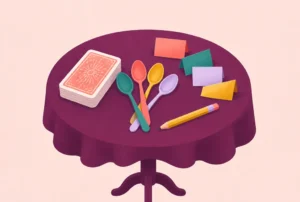
Players pass cards around a table trying to collect four of a kind; the first to do it grabs a spoon, and everyone else scrambles for one too.
How to play
You need
A deck of playing cards, plastic spoons, one fewer than the number of players.
Setup
Put the spoons in the middle of the table in a loose pile. Deal four cards to each player and set the rest of the deck by the dealer.
How to play
- The dealer draws a card, keeps or swaps it with one in hand, and passes one face down to the left.
- Everyone does the same: pick up the passed card, keep four, pass one left. The last player discards into a pile.
- The first player to get four of a kind quietly takes a spoon.
- As soon as anyone sees a spoon gone, they grab one too. The player left without a spoon gets a letter: S, then P, and so on.
- Spell out SPOONS and you become the official dealer for the rest of the game.
Safety notes
- Plastic spoons only, and no diving across the table.
- Hands stay flat on the table between grabs so nobody gets scratched.
Leader tips
- With three players, it’s still tense: put out two spoons and play to S-P-O.
- The sneakiest players take a spoon and keep passing cards like nothing happened.
Two Truths and a Lie
Each player says three things about themselves, one of them made up, and everyone else guesses the lie.
How to play
Setup
Sit in a circle. Give everyone a minute to think of two true facts and one believable lie.
How to play
- The first player says all three statements in any order.
- Everyone else asks one question each, then votes on which statement is the lie.
- The player reveals the lie. Anyone who guessed right gets a point.
- Go around until everyone has had a turn.
Safety notes
- Set a rule up front: nothing that embarrasses someone else, and no secrets you’d regret sharing.
Leader tips
- Leaders go first and set the tone. A silly true fact works better than a dramatic one.
- It’s a good way to start a small group that doesn’t know each other well yet.
Contact
Also called: Word Contact
One player guards a secret word and reveals it one letter at a time; the others team up with clues to force out the next letter.
How to play
Setup
Pick a word keeper. They think of a word of six or more letters and say only the first letter.
How to play
- Any guesser thinks of a word starting with the revealed letters and gives a clue for it, without saying the word.
- If another guesser thinks they know the clue’s word, they say “Contact” and both count down from five, then say their word together.
- If the two words match before the keeper guesses the clue, the keeper must reveal the next letter.
- If the keeper figures out the clue’s word first and says it, that clue is blocked.
- The guesser who finally names the secret word becomes the next keeper.
Safety notes
- Set a clean-words rule before the first round; clues get creative fast.
Leader tips
- Three players is the minimum and it still works: one keeper, two guessers.
- Clues that only your group gets, like an inside joke from camp, are the best way to beat the keeper.
Category Catch
Also called: Hot Potato Categories
Players toss a ball around and must name something in the category before they throw it on.
How to play
You need
A soft ball or beanbag.
Setup
Stand or sit in a circle. The leader names a category: books of the Bible, ice cream flavors, things in a garage.
How to play
- Toss the ball to anyone. The catcher has five seconds to name something in the category, then tosses.
- No repeats. A repeat or a blank earns a letter, like in Spoons.
- When the group runs dry, the leader switches categories.
Safety notes
- Soft ball and underhand tosses in a living room.
Leader tips
- Use Bible categories to review last week’s lesson: people who met Jesus, places Paul visited.
- Speed up the count to three seconds once everyone’s warmed up.
Card Tower Challenge
Build the tallest freestanding tower you can out of playing cards in five minutes, no tape allowed.
How to play
You need
A deck of playing cards or 50 index cards per team, a tape measure, a timer.
Setup
Clear a table, or use a hard floor. Give each player or pair a deck of cards.
How to play
- Start the timer. Players may fold, bend or tear the cards, but nothing else holds them up.
- When time’s up, everyone lets go. The tower has to stand on its own for a count of five.
- Measure from the table to the highest card. Tallest tower wins.
Safety notes
- Keep drinks off the table. That’s mostly for the cards.
Leader tips
- With three players, have them work as one team against the clock and try to beat their own record next week.
- Folding cards into triangles is the trick most people discover around minute three.
Would You Rather
The leader reads two choices; everyone picks one and gives a reason.
How to play
You need
A list of questions.
Setup
Prepare 15 or 20 questions ahead of time. With a small group, everyone answers each one. With a big one, players move to the side of the room that matches their pick.
How to play
- Read the question: “Would you rather be able to talk to animals or speak every human language?”
- Everyone picks. No “neither” and no “both.”
- Each player gets one sentence to explain their choice.
- Let a student read the next question.
Safety notes
- Skip questions about anyone’s body, family money or real fears; this game should never put a kid on the spot.
Leader tips
- Keep a few deeper questions in the list, like “Would you rather have one close friend or ten good ones?” They lead into a conversation without forcing one.
- Questions that start silly loosen a quiet group faster than icebreaker questions do.
Up-front and stage games 6 games
A few volunteers play on the stage while the rest of the room watches and cheers. Ask for volunteers rather than picking people, and keep each round to a minute or two.

Quick Draw
Also called: Draw It, Sketch Race
Two volunteers race to draw the same word on stage while their halves of the room shout guesses.
How to play
You need
Two whiteboards or big paper pads, markers, word cards.
Setup
Split the audience into two halves, each with one artist up front. Put the boards where the room can see them.
How to play
- The leader shows both artists a word card. The audience can’t see it.
- Both artists draw at the same time. No letters, numbers or talking.
- Each side of the room shouts guesses at its own artist. The first side to say the word gets the point.
- Swap in new artists every word or two.
Safety notes
- Keep artists from backing off the edge of the stage while they draw; set the boards well back from it.
Leader tips
- Mix easy words (camel, boat) with hard ones (forgiveness, Tuesday). Hard ones are funnier.
- Use the night’s Bible story for the word list: Noah’s ark, a burning bush, five loaves and two fish.
Straw Race
Also called: Blow Race
Volunteers blow a cotton ball down a lane on a table with a straw, and the first one off the far end wins.
How to play
You need
One straw per player, cotton balls or table tennis balls, a long table and masking tape.
Setup
Tape lanes down a long table, one per volunteer. Put a cotton ball at the start of each lane.
How to play
- Volunteers kneel or bend at one end of the table with a straw.
- On “go,” they blow the ball down their lane, using only air through the straw.
- Touching the ball with the straw or a hand sends it back to the start.
- First ball off the far end wins. Run heats, then a final.
Safety notes
- A fresh straw for every player, and toss them after.
- Kids with asthma can be the referee or the announcer.
Leader tips
- Put a camera on the table and the screen behind the stage if you have one. Straw races look better up close.
- Table tennis balls are faster; cotton balls are harder and funnier.
Variations
- Suction version: move dry cereal pieces from one plate to another by sucking through the straw. No eating them, no racing to swallow.
Cookie Face
Also called: Forehead Cookie
Volunteers put a cookie on their forehead and try to wiggle it down into their mouth without using their hands.
How to play
You need
One soft cookie per player (check allergies), a timer.
Setup
Bring volunteers up front facing the room. Each tilts their head back and a leader places a cookie on their forehead.
How to play
- On “go,” players move the cookie down their face using only facial muscles. Hands stay behind backs.
- If the cookie falls, they can start over with a new one until time’s up.
- First player to get the cookie into their mouth wins. Give it 60 seconds.
Safety notes
- Ask about food allergies first. Use nut-free cookies, and have a gluten-free option on hand.
- Players chew and swallow before talking or celebrating; this isn’t a speed-eating game.
Leader tips
- Use soft cookies, not crunchy ones. They stick better and crumble less in eyes.
- Leaders who play make it twice as funny for the audience.
Cotton Ball Nose Transfer
Also called: Santa's Beard
Volunteers dab petroleum jelly on their nose and move cotton balls from one bowl to another using only their face.
How to play
You need
Petroleum jelly, cotton balls, two bowls per player.
Setup
Set two bowls in front of each player on a table, a couple of feet apart. Fill one bowl with cotton balls.
How to play
- A leader gives each player a small dab of petroleum jelly on the tip of the nose.
- On “go,” players pick up a cotton ball with their nose and drop it in the empty bowl. No hands.
- After 60 seconds, the most cotton balls moved wins.
Safety notes
- Each player gets their own dab from a clean spoon or swab, never from a shared finger.
- Have wipes ready, and keep the jelly away from eyes.
Leader tips
- A minute is plenty. The audience laughs hardest in the first 20 seconds.
- In December, cover a player’s chin with the cotton balls instead and call it a beard. Same game, new costume.
Back-to-Back Drawing
Also called: Describe and Draw
One volunteer describes a picture made of shapes while a partner, facing away, tries to draw it from the words alone.
How to play
You need
Simple pictures made of shapes, paper or a whiteboard, markers.
Setup
Seat pairs back to back on stage. The describer holds a simple shape picture. The drawer gets a board the audience can see.
How to play
- The describer explains the picture using only shapes and positions: “Draw a big circle. Put a small triangle on top of it, a little to the left.”
- The drawer can’t ask questions and can’t look.
- After two minutes, hold the original next to the drawing. The room votes on the closest match.
- Swap roles and run it again.
Safety notes
- Seat pairs on chairs well back from the stage edge.
Leader tips
- It’s an easy setup for a talk about listening or about how messages get garbled.
- Let the audience see the original before the drawing starts. Watching the drawing go wrong is the fun.
Whose Shoes?
Also called: Guess the Feet
Leaders hide behind a sheet with only their shoes showing, and volunteers try to match each pair of shoes to its owner.
How to play
You need
A curtain or a sheet held up by two people.
Setup
Hang a sheet across the stage so it stops about a foot from the floor. Four to six leaders stand behind it, in a mixed-up order.
How to play
- Pull a volunteer up and show them the list of leaders behind the sheet.
- The volunteer walks along the shoes and names the owner of each pair.
- Drop the sheet and reveal. One point per correct match.
- Shuffle the leaders and let a new volunteer try.
Safety notes
- Only leaders who have agreed to it stand behind the sheet. Students can volunteer to guess.
Leader tips
- Leaders who swap shoes with each other before the round make it much harder.
- Do it again later in the year once students know the leaders better.
Water games 7 games
Summer games for a lawn, a parking lot with a hose, or a pool with a lifeguard. Everyone wears shoes or water sandals, and nobody runs on wet pavement.
Water Balloon Toss
Also called: Egg Toss with Water Balloons
Partners toss a water balloon back and forth and take a step apart after every catch; break it and you’re out.
How to play
You need
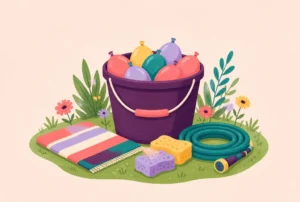
Water balloons, at least one per pair plus spares, a trash bag for scraps.
Setup
Pair everyone up and form two long lines facing each other about 3 feet apart. Give one balloon to each pair.
How to play
- On the leader’s call, everyone with a balloon tosses it underhand to their partner.
- Pairs that catch it without a break both take one big step back.
- A pair whose balloon breaks or hits the ground is out and moves to cheer.
- Keep going until one pair is left.
Safety notes
- Grass only, and shoes on. Wet pavement is slick.
- Latex allergy check before the event. Reusable silicone or fabric water balls work for anyone with a latex allergy.
- Pick up every scrap of balloon when you’re done. Birds and pets choke on them.
Leader tips
- Fill balloons only about three-quarters full; they catch better and break less on the first toss.
- Have the pairs that go out be the scrap-pickup crew during the game.
Water Balloon Dodgeball
Two teams throw water balloons across a center line; get soaked by a direct hit and you go to the sideline until a teammate makes a catch.
How to play
You need
About 10 water balloons per player, buckets or tubs to hold them, cones for a center line and neutral zone, a trash bag.
Setup
Mark a center line on grass with a 10-foot neutral zone on each side. Put an equal number of filled balloons in a tub at each team’s back line.
How to play
- Players take balloons from their own tub and throw from behind their neutral-zone line.
- A balloon that breaks on you below the shoulders sends you to the sideline.
- Catch one without breaking it and the first player waiting on your sideline comes back in.
- When the tubs are empty, the team with more players still in wins. Refill and play again.
Safety notes
- Throws below the shoulders, and no throwing at anyone already on the sideline.
- Fill balloons loosely. Tight, hard balloons hurt, especially at close range.
- Latex allergy check first. Pick up every balloon scrap after the game.
Leader tips
- Fill balloons the afternoon before and store them in tubs out of the sun. Recruit a filling crew; it takes longer than you think.
- Plan for 20 minutes of cleanup. It always takes longer than the game.
Water Balloon Challenge Circuit
Also called: Water Balloon Olympics
Teams rotate through five water balloon challenges and score points at each one.
How to play
You need
Water balloons, beach towels, buckets, cones.
Setup
Set up five stations across a lawn with a leader at each. Split into teams of four to eight.
How to play
- Knee walk: carry a balloon between your knees to a cone and back. Drop it and you start over with a new one.
- Towel launch: two players hold a beach towel and fling a balloon to two teammates with another towel, who try to catch it.
- Over and under: pass a balloon down the line, over the head and then between the legs, and back.
- Sit and pop: race to pop a balloon by sitting on it. No hands.
- Bucket brigade: break balloons over a bucket and fill it to a line. Most water in two minutes wins.
- Rotate every five minutes. Highest total score wins.
Safety notes
- Shoes on, and stations on grass, not concrete.
- Latex allergy check first, and every scrap picked up at the end.
- Water break and shade every 20 minutes on a hot day.
Leader tips
- Give each station leader a clipboard and a score sheet so points don’t get argued about.
- Save sit and pop for last at each rotation; it’s the one teams remember.
Sponge Relay
Also called: Soak and Squeeze
Teams soak a sponge in a full bucket, run it to an empty one, and squeeze it out until the empty bucket fills to the line.
How to play
You need
One big sponge per team, two buckets per team (one full, one empty), a measuring line marked on each empty bucket.
Setup
Put a full bucket of water at the start and an empty bucket about 40 feet away for each team. Mark a fill line on each empty bucket.
How to play
- The first runner soaks the sponge, runs to the empty bucket, squeezes it out and runs back.
- They hand the sponge to the next teammate.
- The first team to fill their bucket to the line wins.
Safety notes
- Grass, not pavement, for the running lane.
- Running in shoes or water sandals only.
Leader tips
- Make the runners carry the sponge on their head, and the game gets much wetter.
- Younger kids can play a walking version and be every bit as soaked.
Variations
- Leaky cup: poke holes in a foam cup and carry it over your head instead of a sponge.
Drip, Drip, Drench
Also called: Duck, Duck, Splash
A wet version of the circle game where the walker drips water on each head and dumps the rest on one player, who chases them around the circle.
How to play
You need
A cup or small bucket, a full bucket of water.
Setup
Players sit in a circle on the grass. The walker fills a cup from the bucket.
How to play
- The walker goes around the outside of the circle, dripping a little water on each head and saying “drip.”
- When they choose, they say “drench” and pour the rest of the cup on one player.
- That player jumps up and chases the walker around the circle.
- If the walker makes it to the empty spot without being tagged, the chaser becomes the walker.
Safety notes
- Pour on heads and shoulders, not faces.
- Run around the outside of the circle, never through it.
Leader tips
- Use cool water from the hose, not ice water; the shock is fun, the cold isn’t.
- Keep a towel by the circle for anyone who wants their glasses dried.
Towel Water Balloon Volleyball
Also called: Balloon Launch Volleyball
Pairs hold beach towels and launch water balloons back and forth over a net, trying to catch them without breaking them.
How to play
You need
A volleyball net or rope, one beach towel per pair, water balloons.
Setup
Set up a net or rope at head height. Split into two teams, then into pairs, and give each pair a towel.
How to play
- One pair on the serving team flings a balloon over the net using their towel.
- A receiving pair must catch it in their towel and launch it back.
- A balloon that lands on the ground or breaks scores a point for the other team.
- Play to 15, then switch sides.
Safety notes
- Keep a few feet between pairs so towels don’t collide.
- Latex allergy check first, and clean up every scrap.
Leader tips
- Pairs who count down together before launching get much better aim.
- It’s a good game for the kids who don’t like getting hit by balloons. Nobody aims at anybody.
Marco Polo
A pool tag game where “It” keeps eyes closed and calls “Marco,” and everyone else must answer “Polo.”
How to play
You need
A pool with a lifeguard on duty.
Setup
Play in the shallow end only. Pick one player to be It.
How to play
- It closes their eyes and calls “Marco.” Everyone else must answer “Polo.”
- It moves toward the voices and tries to tag someone.
- If It thinks someone has left the water, they call “Fish out of water.” Anyone out of the pool becomes It.
- The tagged player becomes the next It.
Safety notes
- A certified lifeguard on duty, plus your own leaders watching the water. Ask families about swimming ability ahead of time.
- Shallow end only, and no diving, jumping on others or holding anyone under.
- Walk on the pool deck, always.
Leader tips
- Rope off the shallow end so the game doesn’t drift into deeper water.
- Rotate It every couple of minutes so nobody spends the afternoon with their eyes closed.
Variations
- Sharks and minnows in the pool: one shark in the middle, swimmers cross from one wall to the other, tagged swimmers become sharks.
- Diving for treasure: toss weighted pool rings in the shallow end and see who brings up the most.
Messy and food games 6 games
Gross-out games that are messy on purpose but still safe. Check allergies before the night, skip anything that’s a choking risk, and tell families ahead of time to send old clothes.
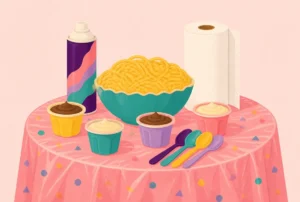
Mystery Taste Test
Also called: Blind Taste Test
Blindfolded volunteers taste strange food combinations and baby foods, and try to name what they just ate.
How to play
You need
6 to 10 small cups of odd but safe foods (see safety), spoons, a blindfold per player, paper and pencils for the audience.
Setup
Line up small numbered cups out of sight. Good options: plain baby foods, pickle juice, mustard on a cracker, sardines, a spoonful of ketchup and applesauce stirred together.
How to play
- Volunteers sit up front, blindfolded.
- A leader hands each volunteer a spoonful from cup one. The audience sees what it is.
- Volunteers taste and guess. The audience writes down whether they’ll get it.
- One point for a right guess, and keep going through the cups.
Safety notes
- Ask about allergies before the night and list every ingredient. Skip peanuts, tree nuts and shellfish entirely.
- Nothing hot, nothing spicy, and no foods anyone has been told to avoid. A player can pass any cup.
- Tiny spoonfuls only. This isn’t an eating contest.
Leader tips
- Baby food is perfect for this; it’s soft, cheap and nobody can tell carrot from squash blindfolded.
- Keep a bucket and water nearby for anyone who wants to spit out a taste.
Spaghetti Toe Grab
Also called: Toe Dip, Gross Feet Grab
Barefoot volunteers fish small toys out of a tub of cold, slimy spaghetti using only their toes.
How to play
You need
A large tub per player, cooked, cooled spaghetti, small rubber toys or wrapped items to find, towels.
Setup
Fill tubs with cooled spaghetti and bury 10 small toys in each. Put towels down under the tubs.
How to play
- Volunteers sit on chairs, shoes and socks off, with a tub in front of them.
- On “go,” they pull out toys with their toes and drop them in a bowl beside the tub.
- Most toys in 60 seconds wins.
Safety notes
- Players stay seated; spaghetti on the floor is very slippery.
- Use toys larger than a golf ball so nothing small ends up near little kids later.
- Wheat allergy? Rice noodles work the same.
Leader tips
- A drop of green food coloring in the noodles makes it look much worse than it is.
- Have a wash bucket and towels next to every chair.
Shaving Cream Puff Catch
Also called: Cheese Puff Head
One partner wears a shower cap piled with shaving cream; the other tosses cheese puffs to stick in it.
How to play
You need
A shower cap per pair, a can of shaving cream, a bag of cheese puffs per pair, trash bags with head and arm holes.
Setup
Pairs stand about 8 feet apart. The catcher wears a trash bag poncho and a shower cap piled high with shaving cream.
How to play
- On “go,” the thrower tosses puffs one at a time at the catcher’s head.
- The catcher can move their head to help, but no hands.
- After 60 seconds, count the puffs stuck in the cream. Most puffs wins.
Safety notes
- Keep the shaving cream on top of the cap, well away from eyes. Have a clean towel and water ready.
- Dairy allergy? Use dairy-free puffed corn snacks. Nobody eats the puffs.
Leader tips
- Play outdoors if you can. Indoors, put down a tarp and play near a sink.
- Leaders as catchers is a good trade for good behavior earlier in the night.
Shave the Balloon
Players cover a balloon in shaving cream and shave it clean with a craft stick before it pops on them.
How to play
You need
A blown-up balloon per player, shaving cream, craft sticks or plastic spoons.
Setup
Each player gets a balloon covered in a thick layer of shaving cream and a craft stick for a razor.
How to play
- On “go,” players scrape the cream off their balloon with the craft stick.
- A popped balloon is out, and usually splattered.
- First to shave the balloon clean, or the cleanest after two minutes, wins.
Safety notes
- Latex allergy check, or use latex-free balloons.
- Hold the balloon away from your face, since a pop throws cream.
- Pick up every balloon scrap afterward.
Leader tips
- Have players hold the balloon between their knees for a harder round.
- Partner version: one holds, one shaves. Swap after each balloon.
Blindfolded Pudding Feed
Also called: Feed Your Partner
A blindfolded partner tries to feed pudding to a seated partner, guided only by their voice.
How to play
You need
A cup of pudding per pair, plastic spoons, blindfolds, trash bag ponchos or old shirts.
Setup
Pairs sit facing each other. The feeder is blindfolded, holds a cup of pudding and a plastic spoon, and wears a poncho. So does the eater.
How to play
- The eater guides the feeder with words only: “Higher. Left. Slower.”
- The feeder spoons pudding toward the eater’s mouth.
- After 90 seconds, the pair with the emptiest cup wins. The messiest pair gets an honorable mention.
Safety notes
- Plastic spoons only, and slow movements. The eater can lean back at any time.
- Check for dairy allergies and offer a dairy-free pudding.
- Swallow before talking. Nobody races to eat.
Leader tips
- Have pairs switch roles for a second round. Everyone wants revenge.
- This one belongs outside, or on a tarp, with wipes within reach.
Mystery Smoothie Wheel
Also called: Gross Smoothie
Teams spin for odd ingredients, the leader blends a smoothie, and each team sends a brave volunteer to take one sip.
How to play
You need
A blender, a spinner or numbered slips, 8 to 10 safe ingredients, small cups.
Setup
Number your ingredients: banana, ketchup, pickle juice, orange juice, plain yogurt or a dairy-free version, mustard, a spoon of baby food, frozen berries. Post the list where everyone can see it.
How to play
- Each team spins or draws three numbers. The leader blends those ingredients with ice.
- Pour a small cup for each team’s volunteer.
- Volunteers take one sip. Anyone who finishes the whole small cup earns a bonus point for their team.
- Repeat with new spins and new volunteers.
Safety notes
- List every ingredient and ask about allergies before the event. No nuts, shellfish or anything a student has been told to avoid.
- One small cup per player, sipped, never chugged or raced. Anyone can pass.
- Keep a trash can and water nearby.
Leader tips
- Let the room vote on which combination they think will taste worst.
- The audience reaction is the show. Put the volunteers on stage.
Night games 6 games
Glow sticks and flashlights on ground your leaders walked in daylight. Every player has a buddy, every leader has a light, and there’s a headcount at the end of every round.
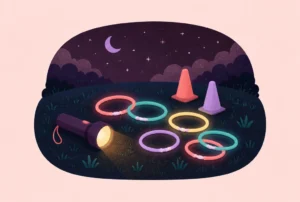
Glow Netball
Also called: Niteball, Nightball, Glow-in-the-Dark Netball
Netball in a dark gym or on a lit-edge court: players wear glow sticks in team colors and pass a glowing ball up the court with no dribbling and no running with the ball.
How to play
You need
A soft ball wrapped in glow bracelets or a light-up ball, two netball goals or basketball hoops, glow sticks: two colors, one per player, glow necklaces for the hoop rims.
Setup
Tape glow necklaces around each hoop rim. Give each team a glow stick color to wear as a necklace or bracelet. Dim the lights, leaving exit signs and a corner light on.
How to play
- Pass the ball to move it. Once you catch it, you have three seconds to pass and may pivot on one foot but not step.
- Defenders stay an arm’s length from the player with the ball and may block passes, not bodies.
- Only players in the scoring half may shoot. Each basket is one point.
- After a score, the other team restarts from center court.
- Play two halves of ten minutes and swap sides at half.
Safety notes
- Walk the court with the lights on first, and clear every bench, bag and chair away from the walls.
- No contact. In the dark, players can’t see a hip or elbow coming.
- Keep exit signs visible and a leader near the light switch.
Leader tips
- The no-running-with-the-ball rule is what makes this work in the dark. Everybody is moving to get open, and nobody is charging down the court.
- Outside, play on a lit court or a smooth patch of grass you’ve checked in daylight.
Ghost in the Graveyard
One player hides as the ghost, the rest count to midnight at home base and go looking, and whoever spots the ghost shouts so everyone races home before getting tagged.
How to play
You need
Flashlights for leaders, a glow stick for each player.
Setup
Pick a home base, like a porch or a big tree, and set boundaries you walked in daylight. Choose one ghost.
How to play
- The ghost hides while everyone else stays at base with eyes closed.
- The group counts out loud: “One o’clock, two o’clock,” and so on up to “Midnight.”
- Then everyone sets out to search together or in small groups.
- Whoever spots the ghost yells “Ghost in the graveyard,” and everyone runs for base.
- The ghost chases. Anyone tagged becomes a ghost too for the next round.
Safety notes
- Walk the whole area in daylight. Mark anything that trips people: sprinkler heads, holes, roots, curbs.
- Buddies search together, everyone wears a glow stick, and a leader stands at each edge of the area.
- No hiding near roads, parked cars, water or in buildings. Headcount after every round.
Leader tips
- Give the ghost a different color glow stick to hide under a shirt; they reveal it when tagging starts.
- A church lawn works better than an actual cemetery. Skip the cemetery.
Flashlight Tag
Tag in the dark where the tagger’s flashlight beam is the tag: catch a player in the beam and call their name to send them to jail.
How to play
You need
Flashlights for the taggers, glow sticks for players.
Setup
Set boundaries and a jail. Give one or two taggers flashlights. Everyone else gets a minute to scatter.
How to play
- Taggers search with flashlights on.
- If a beam lands on a player and the tagger calls their name, that player goes to jail.
- Free players can sneak to jail and tap prisoners to release them.
- The last free player picks the next taggers.
Safety notes
- Point lights at bodies, not eyes.
- Walking pace in any area with trees, slopes or uneven ground.
- Players carry a glow stick so leaders can count them.
Leader tips
- Wrap the flashlight lens in colored cellophane so it doesn’t blind anyone.
- Bigger areas need more taggers. One tagger for every eight players is a good start.
Glow Capture the Flag
Also called: Night Capture the Flag
The classic two-team flag game at night: each team wears its own glow color and defends a glowing flag.
How to play
You need
Glow sticks in two colors, two glowing flags (glow necklaces tied to bandanas), cones with glow sticks for the center line.
Setup
Light the center line with glow-stick cones. Each team hangs its flag in plain sight in its half and marks a jail.
How to play
- Players are safe on their own side and can be tagged on the other team’s side.
- Tagged players go to jail. A teammate can free them by reaching the jail untagged.
- Grab the flag and carry it home across the center line to win.
- If you’re tagged carrying it, the flag goes back to its spot.
Safety notes
- Only on a field your leaders walked in daylight, away from roads, water, ditches and fences.
- Tags are a light touch. No tackling and no flag guarding within 10 feet.
- Set a recall signal, like three horn blasts, and practice it once before dark.
Leader tips
- Glow sticks have to be visible, worn on the outside of clothes, or the game turns into ambush tag.
- Station one leader at the center line with a flashlight to settle disputes.
Glow Stick Hunt
Also called: Glow Egg Hunt
Leaders hide lit glow sticks across a lawn or a dark room, and teams race to collect the most.
How to play
You need
100 or more snapped glow sticks or glow bracelets, a bag per team.
Setup
Snap and hide glow sticks just before the game: in grass, under benches, behind tree trunks. Mix in a few rare colors worth extra points.
How to play
- Teams start together at the edge of the area.
- On “go,” they collect as many glow sticks as they can in five minutes.
- Count them up. Regular sticks are one point; rare colors are five.
Safety notes
- Walk the area in daylight, and keep hiding spots off the ground for very young kids rather than near holes or edges.
- Glow stick liquid irritates skin and eyes. Throw away any stick that’s cracked or leaking.
Leader tips
- Hand out the glow sticks afterward for the next game, so the hunt pays for itself.
- For ages 4 to 6, play in a dark room with the leaders standing in the corners.
Spotlight
Also called: Fugitive, Searchlight
One guard stands at a base with a flashlight; everyone else starts far away and tries to sneak in and touch the base without getting caught in the beam.
How to play
You need
One strong flashlight, a glow stick for each player.
Setup
Pick a base, like a tree or a lit table, and a start line about 50 to 100 yards away on open, even ground. The guard stands at the base.
How to play
- Players start at the line. The guard counts to 30 with the light off.
- Players creep toward the base. The guard sweeps the beam around.
- If the guard catches a player in the beam and calls out who it is, that player walks back to the start.
- The first player to touch the base becomes the next guard.
Safety notes
- Open ground only, walked in daylight. Sneaking through woods in the dark is a sprained-ankle game.
- Glow sticks stay on, tucked inside a shirt pocket if players want, so leaders can still count heads.
Leader tips
- Add a second guard if players are making it in too easily.
- Players who get sent back three times can be the guard’s spotters.
Games with a point 8 games
Each of these games ends with a short talk. Most connect to a Bible passage and a few teach a general character lesson; the discussion questions are where the game earns its time.
Send the Message Relay
Also called: Missions Relay
Teams race to carry a message to four far-off “regions,” but no runner can leave until a teammate sends them, and some regions are harder to reach than others.
How to play
You need
Message cards (a short phrase like “God loves you”) per team, four signs naming world regions, a rope or table to crawl under, a few “language” cards with pictures only.
Setup
Put four region signs around the edges of the room or field. Make one region easy to reach, one behind a crawl-under rope, one that needs a partner, and one where the message must be delivered without words using a picture card.
How to play
- Each team lines up at the start with its message cards.
- No runner may move until a teammate taps them and says “Go.” That’s the sending.
- The runner carries one card to any region, completes that region’s challenge, leaves the card with the leader there, and comes back to send the next runner.
- The first team to deliver a card to all four regions wins.
Safety notes
- Crawl-under ropes stay at least two feet high and loose enough to lift.
- Running lanes stay clear of other teams’ lines.
Leader tips
- Don’t explain why the sending rule exists until the discussion. Let students wonder about it.
- Have the leader at the wordless region respond in a made-up language. It makes the point fast.
The point
Missions: someone has to go, and someone has to send Romans 10:14-15
Talk about it
- Which region was hardest to reach, and what made it hard?
- Romans 10 asks how people will hear if nobody is sent. What did the “sending” rule feel like in the game?
- Who are the people in your own life who haven't heard the message yet?
- What's one way our group could help send someone, even if we aren't the ones going?
Encouragement High Fives
Preteens mill around the room and, on the leader’s call, find a partner for a specific kind of high five, and on “Surprise,” they swap a real compliment instead.
How to play
Setup
Clear the floor. Teach four high fives: up high, down low, behind the back, and double hands.
How to play
- Everyone walks around the room. The leader calls one of the high fives, like “Down low.”
- Players find the nearest person, give that high five, and keep moving.
- When the leader calls “Surprise,” players find a new partner and tell them one specific thing they appreciate about them, instead of a high five.
- Mix calls and surprises for five minutes. Nobody can partner with the same person twice in a row.
Safety notes
- High fives are hand to hand only, and gentle.
- Leaders join in and watch for anyone getting left out; pair up with them yourself.
Leader tips
- Model a good compliment first. “You’re nice” is fine, but “You always save me a seat” is the goal.
- Preteens fake being too cool for this for about a minute. Give it two.
The point
Encouragement: building each other up 1 Thessalonians 5:11
Talk about it
- What's the best thing anyone said to you during the game?
- Why is it easier to joke around than to say something kind and real?
- 1 Thessalonians 5:11 says to build each other up. Who could use that from you this week?
Guided in Truth
Also called: Blindfold Voice Walk, Trust Walk
A blindfolded walker crosses a soft obstacle course guided by one trusted voice, while other players call out wrong directions to confuse them.
How to play
You need
Blindfolds, soft obstacles: pillows, pool noodles, plastic cones, a stuffed animal or two.
Setup
Lay soft obstacles across a clear stretch of carpet or gym floor. Each walker picks a guide. The rest of the group are distractors who stand along the sides.
How to play
- The walker is blindfolded at one end. The guide stands at the far end.
- The guide calls directions to get the walker across without touching an obstacle.
- Distractors call out wrong directions at the same time, using the walker’s name.
- Each obstacle touched is a point against. Swap roles until everyone has walked.
Safety notes
- A spotter walks beside every blindfolded player, close enough to steady them, and says “Stop” if needed.
- Clear floor only, well away from stairs, platform edges, tables and walls.
- Walking pace, arms out in front for the walker.
Leader tips
- With just three players, you have a walker, a guide and one distractor who also spots.
- Ask walkers afterward how they picked out the right voice. Their answers carry the discussion.
The point
Following the right voice Psalm 25:5
Talk about it
- How did you tell your guide's voice apart from the others?
- What “voices” compete for your attention in real life?
- Psalm 25:5 asks God to “lead me in thy truth, and teach me.” What would it look like to ask that this week?
- Who are the people you trust to point you the right way?
Whisper Down the Line
Also called: Telephone, Gossip
A message whispered from player to player down a line comes out the other end hilariously wrong.
How to play
You need
A few message cards.
Setup
Line players up or sit in a circle. The leader writes a message of about 15 words on a card.
How to play
- The first player reads the card silently and whispers the message once to the next player.
- Each player whispers what they heard to the next. No repeats allowed.
- The last player says the message out loud.
- Read the original. Compare.
Safety notes
- Leaders write the message. Never let the starting message be about a real person in the room.
Leader tips
- Messages with names and numbers in them fall apart faster: “Pastor Dave brought 14 pizzas to the bowling alley on Thursday.”
- Run two lines at once with the same message and compare both endings.
The point
Gossip and the power of words James 3:5
Talk about it
- Where did the message start to change?
- Was anyone trying to wreck it? How did it still go wrong?
- James 3:5 compares the tongue to a small fire that sets a big forest burning. Where have you seen that happen?
- What's one thing you can do when a rumor reaches you?
One Body Challenge
Also called: Body Parts Build
Teams of four build a structure, but each player is limited: one can’t see, one can’t talk, one can’t use hands, one can’t move from their chair.
How to play
You need
Blindfolds, a set of 20 plastic cups or building blocks per team, a picture of a target structure.
Setup
Teams of four. Assign roles: the Eyes (can see and talk, but no hands), the Hands (blindfolded, can use hands), the Mouth (can talk, sits facing away), the Feet (can fetch cups but can’t talk or touch the build).
How to play
- Show the Eyes the target picture.
- The Feet fetch cups from a pile across the room, a few at a time.
- The Eyes and the Mouth guide the Hands, who builds the structure.
- First team to match the picture wins. Switch roles and play again.
Safety notes
- The blindfolded Hands stays seated at a table.
- Feet walk, not run, while carrying cups.
Leader tips
- Teams will want to break their role rules. Hold the line; that’s what the discussion is about.
- With bigger teams, add roles: the Ears, who hears the Eyes and repeats to the Hands.
The point
Every part of the body matters 1 Corinthians 12:12-21
Talk about it
- Which role was hardest? Which role did your team need most?
- 1 Corinthians 12:21 says the eye can't say to the hand, “I have no need of thee.” How did your team prove that?
- What part do you play in our group? What part do you wish you played?
Burden Relay
Also called: Backpack Relay
Each runner adds a burden to the team backpack, so the pack gets heavier every leg, until the team discovers it’s allowed to help.
How to play
You need
One empty backpack per team, several light “burdens” per team, like hymnals, water bottles or rolled towels.
Setup
Teams line up. Each has a backpack and a pile of burdens at the start. Mark a turn-around cone 30 feet away.
How to play
- The first runner puts one burden in the pack, wears it, runs to the cone and back, and passes the pack on.
- Each runner adds another burden before running.
- Halfway through, the leader announces a rule nobody asked about: any teammate may run alongside and carry burdens in their arms.
- First team to finish with every burden still in the relay wins.
Safety notes
- Keep the total load light, around 10 pounds at the most. Use soft items.
- Walking allowed. Nobody gets pushed to run with a heavy pack.
Leader tips
- Wait to see if any team asks whether they can help before you announce the rule. That’s the best discussion starter.
- Label the burdens with sticky notes: worry, school, family stuff, a secret.
The point
Carrying each other's burdens Galatians 6:2
Talk about it
- Why didn't anyone help carry the pack until the rule was announced?
- Galatians 6:2 says to “bear ye one another's burdens.” What makes that hard to do in real life?
- What's one burden you'd let this group help you carry?
Silent Line-Up
Also called: Birthday Line-Up
The group lines up in birthday order without talking, then tries again by other rules.
How to play
You need
A tape line or a bench (optional).
Setup
Everyone stands in a loose group. Explain the rule once: no talking, no writing, no phones.
How to play
- The group must line up in order of birthday, January 1 at one end to December 31 at the other.
- Players may use hand signals, gestures and anything else except words or writing.
- When the group thinks it’s done, go down the line and have each person say their birthday out loud.
- Try again with a new sort: shoe size, number of siblings, distance from home to church.
Safety notes
- On a bench, keep it low and have players step down rather than squeeze past each other.
Leader tips
- Time the first attempt and see if they can beat it on the next sort.
- Watch who takes charge and who quietly gets things moving. Mention both in the discussion.
The point
Communication and teamwork (general character theme)
Talk about it
- How did you communicate without words?
- Who led? How did you know to follow them?
- When is it hard to understand people in real life, even when we use words?
Last Shall Be First Race
Also called: Secret Scoring Race
A team obstacle race with a twist: a secret scorekeeper awards points only for serving, like helping a struggling teammate, and none for finishing first.
How to play
You need
Cones, a clipboard for a secret scorekeeper, a few small obstacles.
Setup
Set up a short obstacle course with something hard in it, like a balance beam made of tape or a bucket that needs two people. Choose a leader as the secret scorekeeper. Announce only that “there is a hidden way to score.”
How to play
- Teams run the course in relay order.
- The scorekeeper quietly marks a point every time a player helps someone else: holds a cone, cheers a slow runner home, helps another team.
- Finishing first earns nothing.
- Reveal the scores and how they were earned. Then run it again with everyone in on the secret.
Safety notes
- Keep the obstacles low and soft.
- Help means help: no carrying or lifting other players.
Leader tips
- Don’t hint during the first round. Let them be surprised.
- The second round is usually chaos, with whole teams going back to help. That’s the point.
The point
Serving others, and what “first” really means Mark 9:35
Talk about it
- How did it feel to win the race but lose on points?
- In Mark 9:35, Jesus says whoever wants to be first must be last of all and servant of all. What does that look like at school?
- Who in your life serves people without being noticed?
Sunday school and children's ministry games 8 games
Bible-story and memory-verse games for ages 3 to 11. They’re short, they don’t need much space, and each one ties back to the lesson.
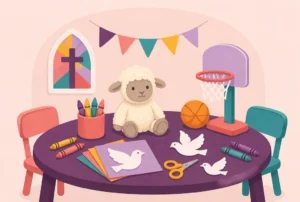
Pin the Stone on the Giant
Preschoolers take turns sticking a paper stone on a poster of the giant Goliath, aiming for his forehead, after hearing the story of David.
How to play
You need
A big paper giant drawn on poster board, paper circles (stones) with tape loops, a soft scarf for a blindfold (optional).
Setup
Tape the giant poster to a wall at the kids’ eye level. Write each child’s name on a paper stone.
How to play
- Tell the story of David choosing five smooth stones and facing Goliath.
- One at a time, each child stands a few steps from the poster, closes their eyes or wears a loose scarf, and walks forward to stick their stone.
- Everyone cheers, wherever the stone lands.
- After every turn, look at all the stones together and count them.
Safety notes
- Paper stones only. No real stones or small objects near children under 4.
- If you use a scarf, a teacher holds the child’s hand all the way to the wall. No spinning.
- Many 3-year-olds don’t like blindfolds; eyes closed works fine.
Leader tips
- Count the stones on the poster out loud: “One, two, three, four, five, just like David.”
- Keep the giant friendly-looking. Big and silly, not scary.
The point
God helps us be brave 1 Samuel 17:40-49
Talk about it
- How many stones did David pick up?
- Was David big or small? Was Goliath big or small?
- When do you need to be brave?
Flying Doves
Also called: Noah's Dove
Kids fly paper doves out from the “ark” and bring back a green leaf, the way Noah’s dove came back with an olive leaf.
How to play
You need
Paper plate doves or white paper airplanes, green paper leaves, a big box decorated as the ark.
Setup
Put the ark box at one end of the room and scatter green paper leaves on the floor at the other end. Give each child a paper dove.
How to play
- Tell the story: Noah sent out a dove to see if the water had gone down, and the dove came back with an olive leaf.
- Kids stand by the ark and throw their doves as far as they can.
- They walk to their dove, pick it up along with one green leaf, and “fly” back to the ark.
- Drop the leaf in the ark and fly again until the leaves are gone.
Safety notes
- Walking, not running, for the youngest ones.
- Throw doves away from faces; point them toward the open end of the room.
Leader tips
- Flapping arms on the way back is required. Teachers too.
- Older preschoolers can count the leaves when the game is done.
The point
God keeps his promises to Noah Genesis 8:8-11
Talk about it
- What did the dove bring back to Noah?
- How do you think Noah felt when he saw the leaf?
Memory Verse Basketball
Teams say the memory verse word by word, and each correct turn earns a shot at the basket, with a far line worth more points.
How to play
You need
A soft ball, a trash can or laundry basket for a hoop, tape for two shooting lines.
Setup
Put the basket against a wall. Tape a close line worth 1 point and a far line worth 3. Write the verse on a board.
How to play
- Read the verse together twice with it showing.
- Erase or cover one word. The first player on team one says the whole verse, filling in the gap.
- If they get it, they take a shot from either line. Then team two goes, with one more word covered.
- Keep covering words until the board is blank and kids are saying it from memory.
Safety notes
- Soft ball only. Keep everyone not shooting behind the line.
Leader tips
- Let kids help each other: a teammate can whisper one word once per turn.
- Psalm 119:11 is a good one to start with, since it’s about memorizing God’s word.
The point
Hiding God's word in your heart Psalm 119:11
Talk about it
- What does it mean to hide God's word in your heart?
- When might this verse help you during the week?
Verse Unscramble
Also called: Scrambled Verse Race
Teams race to put a memory verse back in order from a pile of shuffled word cards.
How to play
You need
One set of word cards per team, each card holding one word or short phrase of the verse, a table or floor space per team.
Setup
Write the verse on cards, a word or two per card, and include the reference as its own card. Shuffle each team’s set.
How to play
- Teams gather at their table with the cards face down.
- On “go,” they flip the cards and arrange the verse in order.
- When they think it’s right, the whole team reads it out loud together.
- First team with it correct wins. Shuffle and try a new verse, or the same one faster.
Safety notes
- In the relay version, runners walk in a classroom; tables and chair legs are close.
Leader tips
- Joshua 1:9 works well: it’s long enough to be a challenge and short enough for a 7-year-old.
- Use the Bible translation your church teaches from so the words match what kids hear on Sunday.
Variations
- Relay version: cards sit at the far end of the room, and each runner may bring back one card at a time.
The point
Being strong and brave because God is with us Joshua 1:9
Talk about it
- Where does this verse say God goes with us?
- Where do you need courage this week?
Throw Away Your Sins
Also called: Into the Sea
Kids privately write or draw a wrong choice on a slip, crumple it and throw it into a tub of water called the sea, then watch it fall apart.
How to play
You need
Small slips of paper, pencils, a big blue tub or bucket of water (the sea), a towel.
Setup
Fill a blue tub with water and set it a few steps from a tape line. Give each child a slip of paper.
How to play
- Read Micah 7:19 together, about God casting sins into the depths of the sea.
- Kids write or draw something they’re sorry for. Nobody else reads it, and nobody has to share.
- They crumple the slip and throw it from the line into the tub.
- Stir the water and watch the slips soak and fall apart. Then pour the whole thing out.
Safety notes
- Teachers never read the slips. Pour the water and paper straight into a trash bag.
- Wipe up splashes right away; the floor around the tub gets slippery.
Leader tips
- Thin paper, like tissue paper or newsprint, falls apart faster and makes the point clearly.
- Take a step back each round for a throwing challenge, then come back to the quiet ending.
The point
God forgives and takes our sins away Micah 7:19
Talk about it
- What happened to the paper in the water?
- Micah 7:19 says God casts our sins into the depths of the sea. What does that tell us about God?
- 1 John 1:9 says if we confess our sins, God forgives us. Is there anything God can't forgive?
Walls of Jericho
Kids build a cardboard wall, march around it the way Israel marched around Jericho, then shout and watch it fall.
How to play
You need
Empty cardboard boxes or paper grocery bags stuffed with newspaper, paper horns or kazoos (optional).
Setup
Stack boxes into a wall in the middle of the room, about as tall as the kids. Leave room to march all the way around it.
How to play
- Build the wall together.
- Tell the story: Israel marched around Jericho once a day for six days. Kids march around once and sit, six times, counting the days.
- On the seventh day, march around seven times, quietly.
- On a signal, blow the horns and give a big shout. A teacher pushes the wall over from behind.
Safety notes
- Empty boxes only, nothing heavy inside, and stacks no taller than the smallest child.
- Kids stand back at least an arm’s length when the wall comes down.
Leader tips
- Counting the marches out loud teaches the numbers as well as the story.
- Let the kids rebuild it and do the seventh day again. They will ask.
The point
Obeying God even when it seems strange Joshua 6:3-5, 15-20
Talk about it
- How many days did the people march? How many times on the last day?
- Why do you think God asked them to march instead of fight?
- Is it ever hard to obey when you don't know why?
Lost Sheep Hunt
Also called: Find the Lost Sheep
Kids hunt for paper sheep hidden around the room and celebrate together when someone finds the special lost one.
How to play
You need
Cotton-ball sheep or paper sheep, one marked with a gold star, a basket for the sheepfold.
Setup
Hide paper sheep around the room before class, at kid height. Hide the gold-star sheep a little harder.
How to play
- Tell the parable of the shepherd who left 99 sheep to find the one that was lost.
- Kids search the room and bring sheep back to the sheepfold basket.
- When someone finds the gold-star sheep, the whole class stops and cheers.
- Count the sheep together.
Safety notes
- Hide sheep only where kids can reach from the floor. No climbing on chairs or shelves.
- Keep hiding spots out of other classes, closets and hallways.
Leader tips
- Older kids can hide the sheep for the younger ones the second time.
- Have a leader quietly help the slower searchers find a sheep or two.
Variations
- Lost coin version from Luke 15:8-10: hide paper coins, and the class searches with a flashlight, like the woman who lit a lamp and swept her house to find hers.
The point
God looks for every one of us Luke 15:4-7
Talk about it
- How many sheep did the shepherd have? How many were lost?
- How did the shepherd feel when he found it?
- Who does Jesus say the shepherd is like?
Fishers of People Tag
Also called: Net Tag
Two fishers hold hands to make a net and tag the other players; everyone caught joins the net until it scoops up the whole class.
How to play
You need
Cones for boundaries.
Setup
Set small boundaries, about the size of a classroom. Pick two players to hold hands as the first net.
How to play
- Read Matthew 4:19, where Jesus calls fishermen to follow him.
- The net chases the “fish” and tags with free hands on the ends.
- Tagged fish join the net by holding hands.
- When the net is six long, it splits into two nets of three. Play until every fish is caught.
Safety notes
- The net jogs, never yanks. If the chain breaks, it stops and reconnects.
- Tags are a light touch on the arm or back.
Leader tips
- Shrink the space for younger kids so the net catches people fast and nobody runs alone for long.
- Let the last fish caught pick the next two fishers.
The point
Following Jesus and bringing others along Matthew 4:19
Talk about it
- What did Jesus say he would make the fishermen?
- How did the net get bigger in our game?
- Who could you invite to church or Sunday school?
Sample plans
Four ready-made plans: a midweek youth night, a small group, a Sunday school class and a summer water night. Swap in your own teaching time and worship. Add a plan to your print list and the PDF starts with a one-page run sheet.
- Open with something anyone can join late. Kids trickle in; the first game shouldn’t punish that.
- Put the game with a point right before the talk so the discussion starts from something the group just did.
- Messy and water games go last, outdoors, with towels and cleanup built into the time.
- Have a no-supply backup for when the plan runs short.
Midweek youth night, 90 minutes
Middle or high school, 20 to 60 students, a gym or fellowship hall · 90 minutes
- The Big Wind BlowsArrival game as students come in10 min
- Straw RaceUp-front game10 min
- Elimination Dodgeball (Soft-Ball Version)Big-room game15 min
- Burden RelayGame with a point to lead into the talk10 min
- Worship and the talk25 min
- Small groups15 min
- Announcements and pickup5 min
Start loose while people trickle in, burn energy with the big game, then use a game with a point as the bridge into the talk. The burden relay’s questions hand the speaker a ready-made opening.
Small group of 3 to 5 students, 45 minutes
A living room, a classroom, or the nights only a few come · 45 minutes
- Two Truths and a LieWarm-up10 min
- SpoonsCard game10 min
- Guided in TruthGame with a point10 min
- Discussion and prayer15 min
Every game here works with three. A quick talking game, something competitive to get them laughing, then a game with a point that sets up the conversation.
Sunday school class, ages 6 to 9, 45 minutes
8 to 15 kids, a classroom · 45 minutes
- Welcome and opening5 min
- Walls of JerichoStory game10 min
- Bible story and discussion10 min
- Memory Verse BasketballMemory verse game10 min
- Throw Away Your SinsResponse activity5 min
- Snack, cleanup and pickup5 min
Act out the story first so kids are paying attention when you teach it. The verse game turns memorizing into points, and the quiet response activity calms things down before parents arrive.
Summer outdoor and water night, 2 hours
Any youth group, a church lawn, a hose and a lot of towels · 120 minutes
- Sponge RelayWarm-up race15 min
- Water Balloon TossPartner game15 min
- Water Balloon DodgeballMain event15 min
- Dry off, snack and water15 min
- Short talk15 min
- Cleanup: every balloon scrap off the grass10 min
- Glow NetballDusk game20 min
- Ghost in the GraveyardNight game15 min
Get wet while it’s hot, dry off for the talk, then move to glow games as it gets dark. Pick up the balloon scraps before dusk; it’s nearly impossible once the light goes.
Safety, child protection and what we left out
Every game has its own safety notes. These are the rules underneath them. Your church’s or organization’s child protection policy and insurance requirements come first; where they’re stricter than anything here, follow them.
Supervision and child protection
- Follow your child protection policy on screened adults, ratios and never being alone with one child. Many churches require two unrelated adults in every room.
- Count heads before and after every game, and especially after night games and hide-and-seek games in a church building.
- Set off-limits areas clearly: kitchens, closets with chemicals, stairwells, platforms and anywhere outside the building.
Food, allergies and choking
- Ask about food allergies before any food or messy game, and keep a written list. Swap common allergens (peanuts, tree nuts, dairy, gluten) for safe items.
- No racing while eating, and nothing small, round and hard for young children.
- Check for latex allergies before using balloons; latex-free balloons exist.
Water and night games
- Shoes on, no running on wet pavement, and a dry towel station. Pick up every scrap of balloon afterward; pieces are a hazard for wildlife and small children.
- Night games only on ground the group has walked in daylight, with a glow stick on every player, a buddy system and a clear recall signal.
- Anything in a pool or lake needs a lifeguard and your organization’s aquatics rules.
Inclusive play
- Anyone may sit out any game, no reason needed. Give them a real job: judge, timekeeper, scorekeeper.
- Pick teams by counting off or drawing cards, never by captains choosing one by one.
- Messy games are opt-in. Never put food on someone who hasn’t chosen to play.
What we left out on purpose
- Stuffing the mouth with marshmallows while talking: children and adults have choked to death playing it, so we don't include it in any form.
- Eating races and speed-eating contests, especially with peanut butter, nuts or other common allergens: racing to swallow is how choking happens, and allergies turn a joke into an emergency.
- Games that single someone out for humiliation, like roasting a volunteer or making one student the butt of a prank: the kid on stage remembers it longer than the room does.
- Initiation or hazing games for new students or new leaders: a welcome should never include fear, pain or embarrassment.
- Blindfold games near stairs, stage edges or tables, or any blindfold game without a spotter.
- Dodgeball with hard balls or at close range: we only include the soft foam version with a neutral zone.
- Fake kidnappings or abduction pranks, even as a surprise: they frighten kids, alarm neighbors and can end with a call to the police.

Printable game cards
Every game prints as a half-page card with setup, numbered rules, safety notes, leader tips and, for games with a point, the discussion questions. Print your list, the games your filters show, or all 55. Hand a card to the volunteer running the game. Cards are built in your browser, and nothing is uploaded.
Ready-made PDFs of all 55 cards: US Letter · A4. Print at 100% (“Actual size”). More help: printing tips.
For youth leaders, children’s ministry directors and librarians
No ads, no sign-up, no email wall. Free to print and copy for your ministry.
You’re welcome to link to this page from a church website, a volunteer handbook, a resource list or a library guide. To cite it:
Party Game Book Editors. (2026). Youth ministry games: A library of games for youth groups, Sunday school and church events. Party Game Book. https://partygamebook.com/youth-ministry-games/
Party Game Book Editors. “Youth Ministry Games: A Library of Games for Youth Groups, Sunday School and Church Events.” Party Game Book, 2026, partygamebook.com/youth-ministry-games/.
Every game has its own address, for example partygamebook.com/youth-ministry-games/#glow-netball
- 55 games in 8 types, each with group size, ages, space, time, energy, mess level, setup, rules, safety notes and leader tips.
- 16 games with a point, each with a theme, a Bible reference where it fits, and discussion questions.
- Original write-ups of traditional games. We didn’t invent them and don’t claim to; the wording and the safety notes are ours.
- Non-denominational. No doctrine beyond the passages cited.
- Last reviewed: October 2026. Found a mistake? Email hello@partygamebook.com.
Sources and further reading
- Bible references were checked against the King James Version (public domain). Read any passage in several translations at Bible Gateway.
- National Weather Service, heat illness and lightning safety.
- Food Allergy Research and Education, FARE (allergy basics for event planners).
More free games from Party Game Book
- The Group Games LibraryIcebreakers, name games and team challenges with debrief questions.
- Troop and den gamesField, campfire and rainy-day games for youth groups.
- How to play classic gamesCard, dice and board game rules for the lock-in.
- Would you rather questionsHundreds of prompts for small groups.
- Never have I ever questionsClean prompts for a get-to-know-you night.
- The Game MakerMake and print your own bingo and trivia.
0 cards